(You can download a PDF copy here.)
Author’s Note
This Article was written during this time of deepening polarization in the country, when impeachment—once a rare and solemn constitutional remedy—risks becoming a political reflex. It does not argue for or against the removal of any particular public official, nor is it aligned with any partisan cause. I am not part of the political mainstream, nor do I pretend to speak from within its circles. I write this more as an Ilocano who grew up in the quieter barangays far from Manila’s halls of power, trying to make sense of how our constitutional processes are being shaped—and sometimes misshaped—by the noisy, sometimes cruel, world of social media.
Like many of us raised on panagbabain (a deep cultural value of propriety and modesty), I hesitate to call out our institutions too quickly. But silence, especially among those trained in the law, can also enable distortion. My intent here is not to fan partisan outrage but to ask harder questions: about how power is exercised, how due process is honored, and how truth is framed when digital virality threatens to overtake constitutional fidelity.
Impeachment is not just a legal mechanism—it’s a civic mirror. If it reflects more noise than principle, perhaps the problem is not in the mirror, but in the room.
I. Impeachment in the Digital Age
Mention “impeachment” during your morning commute—say, anywhere from North EDSA to Ayala Avenue—and you’re likely to provoke spirited debate, or at the very least, a measurable spike in blood pressure. What was once the gravest constitutional remedy has begun to resemble a kind of political ati-atihan: an ephemeral burst of noise and excitement, a vibrant escape that, by the next morning, was just a memory. Once a last constitutional resort to hold the highest public officers accountable, impeachment today is too easily deployed as a partisan instrument, often less to protect the rule of law than to rattle the other side when sufficiently annoyed.
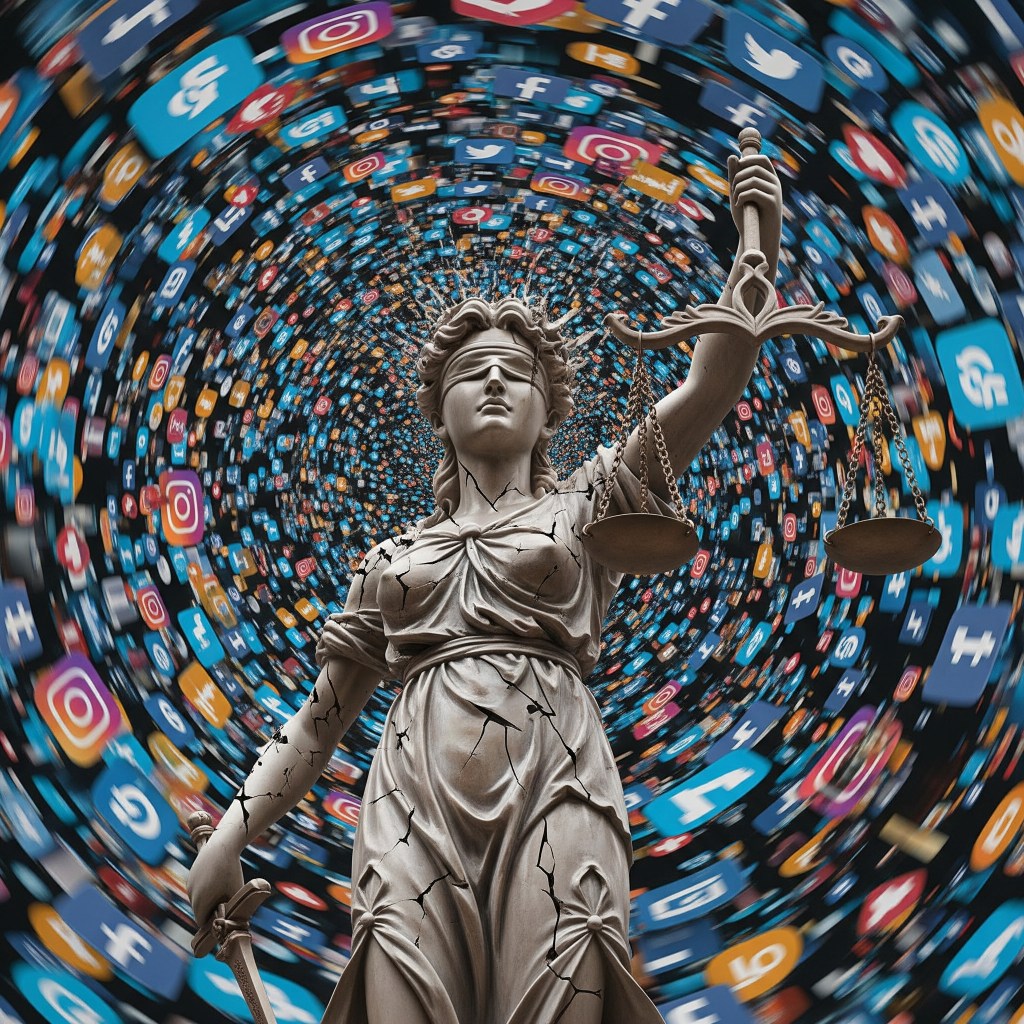
In this digital age, marked by algorithm-driven outrage and relentless media cycles, impeachment has drifted from its constitutional moorings. It now unfolds less like a solemn institutional process and more like a made-for-streaming spectacle. The verdict is rendered not in the Senate chamber, but in the court of public opinion—frequently long before any witness takes the stand or any evidence is formally introduced. This is no accident; it is a symptom of a political and technological environment that rewards outrage, not deliberation.
This evolution—or more accurately, devolution—is no trivial shift. However understandable the public’s cynicism may be, it threatens to trivialize a remedy designed to be anything but. The concern is not that impeachment has become politicized; it always has been, and even the framers of the U.S. Constitution, upon which the Philippine framework is modeled, accepted that politics was an inescapable element (Federalist No. 65). Madison and Hamilton would not have expected partisanship to vanish—they would have expected the process to survive despite it. The deeper problem lies in how our media environment—especially social media—has accelerated the erosion of seriousness that impeachment once commanded.
Today’s digital platforms thrive not on clarity or truth, but on speed and sensation. As Sunstein (2020) notes, the structure of online discourse encourages “outrage cascades,” where people double down on existing beliefs and dismiss anything that challenges their political instincts. The result? A process that may still follow constitutional form but has grown brittle in substance.
This article takes a closer look at that tension. It begins with the sui generis character of impeachment—why it was never meant to resemble an ordinary trial—and how that uniqueness has been undermined by the digital information economy. It then explores how traditional and social media have transformed the process into a spectacle, and finally, what’s being lost along the way: constitutional seriousness, the integrity of due process, and the public’s understanding of both. Because if we don’t understand the arena, we can hardly pretend to understand that the fight is about us.
II. A Constitutional Sui Generis
To speak with a modicum of seriousness about impeachment, we must begin by clearing a common misconception: impeachment is not a courtroom drama. It may look like a trial, it may sound like a trial—but constitutionally, it isn’t one. Not in the Philippines. Not in the United States, from which much of our framework is drawn. As our own Supreme Court has repeatedly emphasized, impeachment is sui generis—a constitutional creature that is part legal, part political, and wholly unique (Francisco v. House of Representatives, 2003).
Let’s not pretend it’s about jail time—it’s not. The most the Senate can do is remove the official from office, and at its discretion, disqualify them from holding public office in the future. That’s the sum total of the sanction. There are no fines, no incarceration, and no penal consequences flowing directly from impeachment. Criminal liability may follow in a separate proceeding, but impeachment itself is neither a precursor to, nor a substitute for, prosecution. It stands apart. Accordingly, we do not apply the “proof beyond reasonable doubt” standard. The evidentiary burden is lighter, often hovering somewhere between “preponderance of the evidence” and, in more serious cases, “clear and convincing evidence” (Gerhardt, 2000). That makes sense: this isn’t about guilt or innocence in the penal sense—it’s about constitutional fitness for public trust.
This distinction isn’t just academic. It’s structural. Under Article XI, Section 3(6) of the 1987 Constitution, the Senate has the “sole power to try and decide all cases of impeachment.” Sole means sole. The judiciary has no business second-guessing the Senate’s conduct of the trial—its procedure, its timeline, even its evidentiary rules. The U.S. Supreme Court said as much in Nixon v. United States (1993), when it declined to review the Senate’s procedures in removing a federal judge, holding that the impeachment process was textually committed to the Senate and therefore nonjusticiable. Our own jurisprudence walks the same doctrinal path: impeachment is generally a political question beyond the courts’ reach—save perhaps in extreme cases involving grave abuse of discretion amounting to lack or excess of jurisdiction (Bandila ng Bayan v. Ermita, 2005).
But therein lies the first constitutional wrinkle. The same provision that grants the Senate this “sole power” also requires that the trial shall “forthwith proceed” once the House transmits the Articles of Impeachment. Forthwith doesn’t mean someday—it means promptly, within a reasonable period. And yet, in this high-profile impeachment, the Senate took nearly four months to formally organize itself as an impeachment court. When it did, it busied itself with caucuses, preliminary motions, and procedural jousting before any real trial commenced. In a courtroom, we’d call that pre-trial. In the Senate, it’s just business as usual. And why? Because it can—because “sole power” means just that.
This tension—between the textual command for immediacy and the Senate’s procedural latitude—reveals the core nature of impeachment: it is a constitutional balancing act between form and function, legal rigor and political discretion. Its design prioritizes flexibility. But that same flexibility is its greatest vulnerability. It is not always the built-in ambiguity that invites strategic political maneuvering; as we’ve observed, it is the bad faith of the main actors that undermines that solemn process. And if we are to remain honest about the institution, we must acknowledge that the Constitution permits this tension—and leaves the rest to political courage and a patriotic sense of duty.
III. The Echo Chamber and the Spotlight
If impeachment is a constitutional beast, then the public square in which it roams has become something altogether more feral in the digital age. We are well past the time when impeachment trials could unfold with any real hope of sober, deliberative quiet—filtered, however imperfectly, through traditional media with at least some pretense of editorial restraint. Today, the process is not just covered and live-streamed. It is curated, weaponized, and fed through an algorithmic machine that rewards heat over light (Sunstein, 2017).
This is no longer just about the 24-hour news cycle. This is about echo chambers. Social media platforms, engineered for virality, have become perfect incubators for epistemic closure—pushing users into self-reinforcing bubbles of belief. A user inclined to believe a public official is guilty will find an infinite scroll of outrage, “receipts,” and bite-sized video breakdowns masquerading as legal analysis. Another, convinced of innocence, will be fed a steady stream of counter-content: lawyer-reacts videos, amateur explainer threads, and memes of defiance. The algorithms do not care about truth. They care about engagement (Pariser, 2011). And the casualty is nuance, context, and the careful, sometimes uncomfortable, work of fact-finding.
This dynamic was already visible in the impeachment of President Joseph Estrada in 2000. Traditional media coverage, especially television, played a crucial role in shaping public opinion—most notably during the dramatic walkout of prosecutors, an event broadcast live and replayed incessantly until it catalyzed what became EDSA II (Teehankee, 2001). The trial never reached a verdict; public outrage got there first. But the Estrada episode, while powerful, occurred in a pre-social media world. Its velocity was driven by mass media. Its amplification, however, was still channeled through editors and producers.
By the time Chief Justice Renato Corona faced impeachment in 2012, that gatekeeping had all but collapsed. Social media had arrived as both a political weapon and a judicial theater. Livestreams of the proceedings were watched and rewatched across Facebook and YouTube. Hashtags trended. Leaked documents and salacious speculation spread faster than the Senate could schedule motions. The trial of the Chief Justice was no longer merely a constitutional exercise—it was a spectacle, where senators gave dramatic speeches not just to their peers, but to their followers, fans, and base (Arugay, 2012). Legal theory had to compete for airtime with viral appeal.
In the United States, the impeachments of Donald Trump—twice—followed the same logic, but at greater scale. The proceedings were not only televised but also live-tweeted, TikToked, and meme-ified. Clips were extracted and reframed to feed partisan narratives (Abramson, 2020). Senators were not just jurors; they were political actors operating under the constant scrutiny of their constituents and the algorithms that shaped them. During Trump’s first trial, polling showed that a majority of Americans had already made up their minds about his guilt or innocence before the Senate even convened (Gallup, 2020). The second trial, following the January 6 Capitol attack, was decided in the court of public opinion almost as quickly as the Articles were filed. In both cases, the process became less about evidence and more about narrative control.
This dynamic is particularly acute in the Philippine setting, where political discourse is hyper-mediated and highly visual. Impeachment trials here are not just broadcast—they are dissected in real-time on Facebook, X (formerly Twitter), and TikTok, where the lines between information, analysis, and partisan storytelling collapse entirely. Legal arguments are flattened into soundbites; procedural rulings become ideological litmus tests. Senator-judges find themselves caught between legal duty and political branding, with every statement clipped, memed, and repurposed for content (Tigno, 2013).
What results is a dangerous kind of constitutional theater. The trial, conceived by the framers as a mechanism for accountability insulated from popular whim, becomes a kind of real-time referendum where constitutional fitness is judged not by reasoned vote but by viral appeal. The gravity of the proceeding is displaced by the velocity of the news cycle. And in this race, truth often comes in last. This is not a Luddite lament. Transparency is a constitutional good. But when transparency mutates into performative outrage, and when the space for careful legal reasoning is swallowed whole by the attention economy, we should not pretend that the process is merely evolving. It is being redefined. And not necessarily for the better.
IV. Erosion of Constitutional Norms
This is where the rubber meets the road—or, more precisely, where the digital din threatens to shred the constitutional fabric. Media and social media aren’t mere backdrops to impeachment; they actively undermine the norms and principles that give the process its solemn legitimacy.
Consider the challenge to impartiality. In the Philippines, Senator-Judges, before sitting in an impeachment trial, swear to “do impartial justice according to the Constitution and the laws of the Philippines” — a solemn oath institutionalized by Senate rules (Senate Impeachment Rules, Rule IV). And yet, they sit amid relentless online scrutiny, their every move parsed and politicized within minutes. Every statement is over‑amplified, dissected, and remixed. When their political survival hinges on satisfying a vocal digital base, neutrality becomes a fiction—and the integrity of the process suffers (Arugay, 2013; Tigno, 2015).
Then there’s the distortion of due process. Ideally, impeachment should proceed with presumption of innocence, full argument, and evidentiary sway. In practice, viral narratives win out, and verdicts are rendered long before a witness testifies. That said, the impeached official herself exploited those same mechanisms—using dilatory tactics like pre‑trial applications, selective leaks, and public broadcasts to shape online sympathy. Thus, the public scrutiny may lack nuance, but it’s often self‑generated (Picazo, 2023). While due process remains formally in place, it risks being hollowed out both by the digital mob and by strategic manipulation (Nunziato, 2022).
Lastly, consider the erosion of constitutional norms. Impeachment was meant to be rare and reserved for monumental breaches of trust (Senate, 1987). But when it’s wielded as a partisan weapon—with digital pressure overriding institutional deliberation—its gravity erodes. Moreover, when the Senate’s “sole power” is subtly guided by online clamor rather than principled judgment, its constitutional backbone weakens (Quevedo, 2014; Postema, 2021). The digital age places immense strain on impeachment’s integrity. A vital constitutional safeguard risks devolving into a predictable, politically charged ritual—where the loudest voice, not the soundest judgment, prevails.
V. Reclaiming Informed Constitutional Discourse
So where does that leave us? Is impeachment fated to remain a high-stakes partisan cage match—its constitutional teeth dulled by the clamor of viral outrage and media spectacle? Not necessarily. But restoring its original force and fidelity won’t happen by accident. It demands something deeper than good intentions—it requires a civic culture grounded in constitutional literacy and public responsibility.
The first mirror must be held up to the media. Yes, the architecture of modern journalism has shifted toward speed, virality, and engagement—but that’s no excuse for abandoning its public trust. Journalism cannot merely traffic in spectacle. It must resist turning each procedural wrinkle into a headline-grabbing twist and instead work toward contextual reporting, verified facts, and a deeper public understanding of impeachment as a unique constitutional process (Marder, 2012; Arugay, 2013). This means going beyond the horse race and into the constitutional weeds—educating, not entertaining.
But the burden doesn’t lie with media alone. Citizens, too, carry a civic obligation—to resist the gravitational pull of partisan instincts and cultivate constitutional discernment. Impeachment is not just a procedural game for lawyers and legislators. It’s a structural safeguard whose integrity rests, in no small part, on whether the public demands substance over noise. The “court of public opinion” may never go silent—but it need not be ignorant. Every vote, every share, every post carries normative weight. And if we claim to care about democratic accountability, we must care about the integrity of the process that makes it real (Tigno, 2015; Postema, 2021).
Then comes the role of constitutional actors. Elected representatives, legal professionals, scholars, and even judges—yes, those outside the impeachment arena—must insist on principle. That means resisting the temptation to bend impeachment toward short-term political gain. It means holding the line on due process—even for the unpopular or the already-condemned online. And it means recognizing that the Senate’s “sole power” (Const., art. XI, sec. 3[6]) is not a blank procedural check but a grave constitutional trust. As the U.S. Supreme Court reminded in Nixon v. United States (1993), the Senate’s discretion in impeachment is insulated from judicial review not to grant unchecked latitude, but because it bears a weight only constitutional conscience can carry.
Leadership matters — not because it dictates the outcome of every impeachment, but because it sets the tone for how constitutional accountability is understood. When high-ranking officials reduce impeachment to political theater or weaponize public outrage instead of reinforcing institutional discipline, they signal that the Constitution is a script to be spun, not a framework to be honored.
Indeed, the framers of both U.S. and Philippine models of impeachment did not design this mechanism to serve politics. They designed it to check the abuse of public trust (The Federalist No. 65; Bernas, 2009). But even a well-designed mechanism can be hijacked, dulled, or ignored. Its continued legitimacy depends on whether we—the public, the press, and the constitutional actors—treat it as a sacred tool, not a political toy. Impeachment remains vital. It is not obsolete. But its strength does not lie in its repeated use, nor in its theatrical potential. It lies in whether it is invoked solemnly, administered fairly, and understood clearly. In the end, constitutional accountability is not a foregone conclusion. It must be reclaimed—in the hearing rooms of the Senate, and in the noise of the public square—each time the mechanism is called into action.
-end-
(Download a pdf copy here which includes the list of references.)

