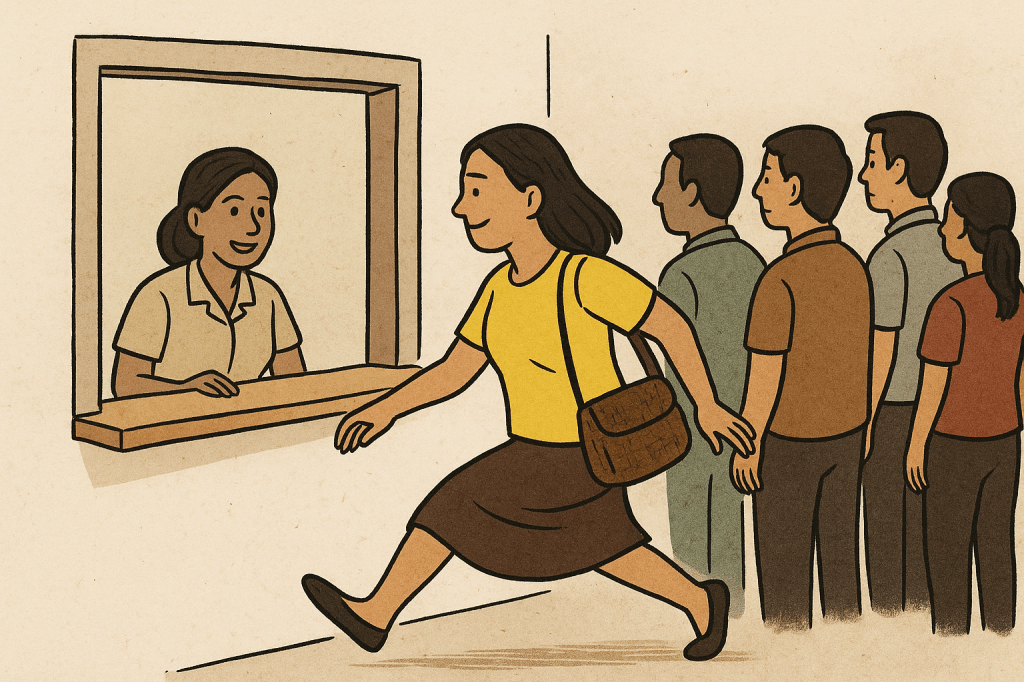
I was in line at the municipal hall recently, waiting to process a routine document. The line was long enough to test both patience and faith. Ahead of me, I noticed a woman quietly step forward toward the window, bypassing at least twenty of us. She nodded at the clerk, exchanged a quick smile, and her papers were processed in minutes.
No one protested. A few even smiled in understanding.
Someone behind me whispered, “Ah, kakilala.”
And just like that, the moment made sense. Not fair, not right—but familiar.
We like to say Filipinos are warm, community-oriented, always ready to help. We take pride in Kapwa—this belief that we are connected, that we share something deeper than just space or citizenship. It’s a beautiful idea. It’s why neighbors come together after storms, why we let relatives sleep in our houses without asking how long, why we stretch our budgets to help family even when it hurts.
But something happens to Kapwa when politics enters the room.
The concept that once meant shared humanity slowly narrows—shrinks—until it applies only to the people who are ours: our family, our fraternity brother, our batchmate, our kababayan. The bigger community—the nation—becomes someone else’s problem. Someone else’s duty. Someone else’s money.
This is how corruption gets justified long before it even happens.
When a mayor hires half the municipal office from his own relatives, supporters say, “Well, at least he’s helping his own.”
When a governor diverts funds to build a road leading only to his family’s resort, the defense is, “He takes care of us. That’s what matters.”
When a senator hands out scholarships funded by siphoned public funds, the recipients will swear he is a kind and generous leader.
And truly—many of them are kind and generous.
But generous with money that was never theirs.
The state becomes the ibang tao—the outsider.
The government becomes the faceless “they.”
And stealing from an outsider doesn’t feel like stealing at all.
Meanwhile, being loyal to your Kapwa—the smaller circle—feels like the moral thing to do.
This is why you will hear people say things like:
- “At least our mayor shares the blessings.”
- “He may be corrupt, but he helps our town.”
- “Nanalo tayo.”
And there it is again: tayo.
The tribal “we.”
The tragedy is that Kapwa was meant to expand outward—from family, to community, to region, to nation. It was supposed to be a moral circle that grows, not shrinks. But in modern Philippine politics, Kapwa contracts. It becomes a shield to excuse wrongdoing and a tool to keep loyalty unquestioned.
This is how corruption becomes not just tolerated—but expected.
It is framed not as theft but as duty.
Not as greed but as care.
A mayor who refuses to give jobs to his relatives may be called “walang puso.”
A leader who insists on fair process may be labeled “masyadong legalistic.”
A public servant who keeps boundaries may be accused of being cold.
In a culture where closeness is virtue, integrity can look like betrayal.
And those who benefit from the system—those who get priority in the municipal hall line, those who receive “ayuda” first, those whose applications are approved faster—have no incentive to want change. Why demand fairness when the unfair system works in your favor?
So the system stays broken.
Loyalty stays personal.
And national duty remains abstract.
The woman at the window got her papers done in minutes. I waited another two hours. I wasn’t angry. Just aware.
Because I understood the logic.
Because I have benefited from that same logic at other points in my life.
Because we all have.
That’s the quiet truth:
We are not just victims of this system.
We are participants in it.
Kapwa is not the problem.
The shrinking of Kapwa is.
If Kapwa is to be our strength again, it must grow bigger than our own table, our own street, our own last name. The same care we give our inner circle must extend to the person we do not know—the stranger, the taxpayer, the future citizen who will inherit what we either fix or allow to decay.
Imagine a country where we treat the national budget as personal money—not because it benefits us privately, but because it belongs to all of us collectively.
We already know how to care deeply.
We just need to widen the circle again.
(Thumbnail image generated by Grok.)

