The other day, I was inching my way through EDSA on my way to the IBP office to update my membership. The usual Metro Manila experience: cars barely moving, motorcycles weaving through impossible gaps, everyone in varying degrees of silent frustration. Then there was the driver behind me, a Toyota Fortuner, who was visibly impatient—edging forward, inch by inch, determined to get ahead even though none of us were going anywhere. Eventually, he forced his way just inches in front of my twenty-year-old CRV. I caught myself thinking: maybe he simply could not stand the idea of staring at my old SUV for five more minutes.
But as traffic does, it gave me time to think. I remembered something my friend and mentor, Atty. E. Salonga, once told me. He said the Filipino is “a race of tricksters.” Not as a criticism, but as a reflection. We survive by finding clever ways around things. And that Fortuner driver, gaining just half a car-length of progress in a standstill, felt like a small example of it. He didn’t really get further. We would all arrive at roughly the same time. But in his mind, nakalamang siya. And sometimes, that is the only victory that matters.
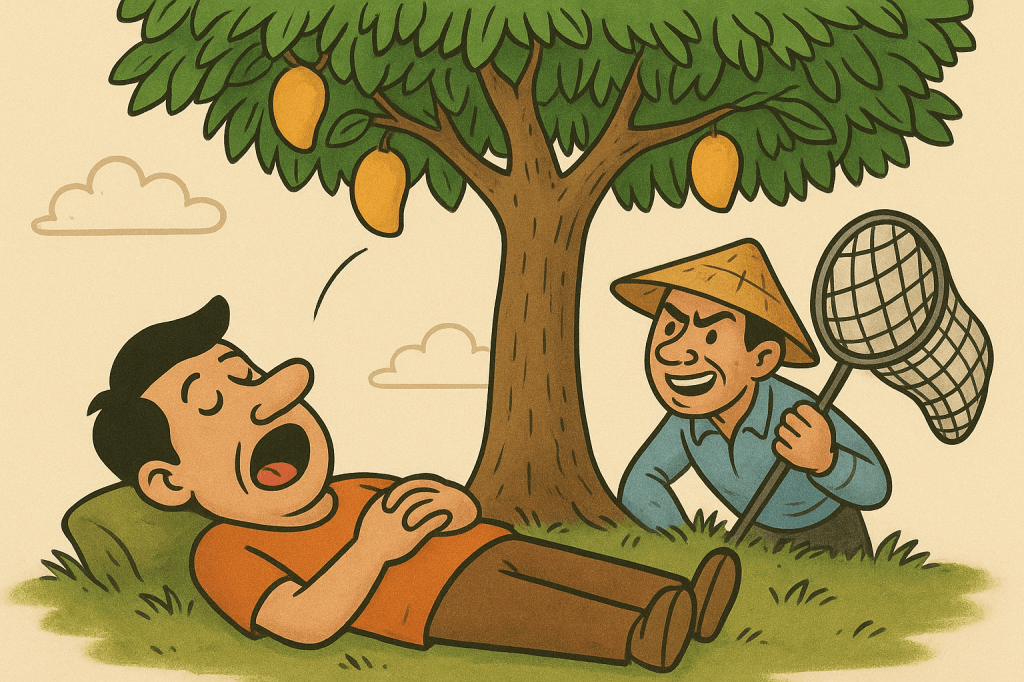
That moment made me realize how corruption in this country is not always about the big scandals or dramatic exposés. Sometimes, it’s in the ordinary habits we’ve accepted as normal. We see it in the familiar tension between two old characters we all grew up with: Juan Tamad and Juan Pusong.
Juan Tamad, in the modern world, isn’t simply someone who is lazy. He is someone who has learned that effort rarely pays off. He becomes the employee who stops trying because initiative is not rewarded. The engineer who no longer argues for proper materials because the project will be delayed or redirected anyway. His laziness is learned. Embedded. Passed on through the phrases we toss around so casually: bahala na and pwede na.
Bahala na once meant courage in uncertainty; now it’s often a polite surrender. Faced with difficulty, someone simply lets the problem drift to the next office, the next memo, or the next administration. Pwede na is the quiet acceptance of mediocrity. It’s how potholes keep returning, why documents still require ten signatures, and why public infrastructure seems to crumble faster than it is built.
This slow, heavy, inconvenient system—that’s Juan Tamad’s domain.
And where systems fail, Juan Pusong enters.
Juan Pusong is not lazy. He is clever. He works around problems, not through them. He survives by diskarte. Faced with the same slow system, he says, “If I wait, nothing happens. So I won’t wait.” And this is where kakilala culture grows—not just out of privilege, but out of necessity. When the official process is painfully slow, the only workable path becomes knowing someone who can push your papers upward in the pile.
And because this approach works—and works quickly—we celebrate it. We admire the person who “knows how to move.” And in doing so, we quietly keep the broken system alive.
That’s the real cycle: the inefficiency created by the modern Juan Tamad forces ordinary people to adopt the tactics of Juan Pusong. And the success of Juan Pusong then removes the pressure to fix the system Juan Tamad works in. One sustains the other.
This is why many anti-corruption reforms fail. They focus on punishment, enforcement, and rules. But they don’t change what the system actually rewards. We cannot expect honesty to flourish when honesty is the slowest and most frustrating option.
So maybe the real reform is much simpler than we think: make the honest path the easiest path. Clear steps. Transparent processes. Deadlines that mean something. Offices that function without requiring a kakilala. If we do that, cheating loses its benefit. Laziness loses its hiding place.
As I finally reached the IBP office that day, after nearly an hour of crawling through traffic, I thought back to the Fortuner driver. If the road were clear, would he have forced his way forward? Probably not. When things move the way they should, diskarte loses its appeal.
Maybe the real challenge now is to stop tolerating systems that demand trickery, and stop admiring the cleverness that gets around them. To decide, simply, that we are tired of being either Juan.
If we can make the straight path the easy one, we won’t need tricksters—and we won’t need shortcuts.
And maybe, just maybe, we’ll finally start moving forward—together.
(Thumbnail image created by Grok.)

