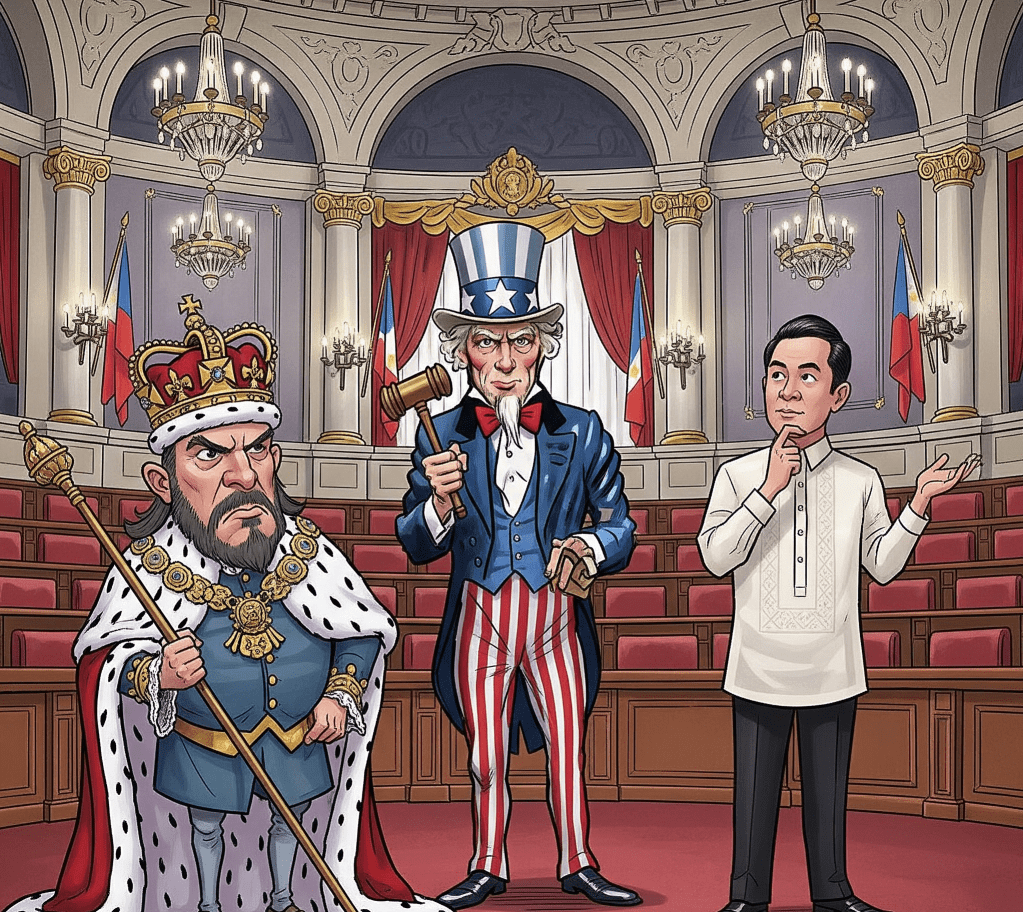
By: Atty. Bernard D. Bandonell
(You can download a PDF copy here.)
Impeachment stands as a powerful tool for accountability, a constitutional mechanism designed to hold high public officials responsible for grave abuses of power. While often associated with modern democracies, its origins lie deep in English parliamentary history, evolving over centuries before being adapted by nascent republics. This document traces that fascinating journey, culminating in a reflection on its complex and often contentious application in the Philippines.
The English Origins (14th – 18th Century)
The concept of impeachment was not an American invention. It emerged in medieval England as part of Parliament’s broader effort to limit monarchical power and assert institutional oversight. The first recorded impeachment occurred in 1376 during the reign of an aging King Edward III, a period in English Parliament now remembered for what modern historians refer to as the “Good Parliament.” That label reflects the Parliament’s unusually active stance in confronting corruption and misrule in royal government, including its initiation of the first formal impeachment proceedings against Lord William Latimer, a close associate of the king, who was accused of financial misconduct and abuse of influence (Haskins, 1914).
The House of Commons, acting as the representative body of popular grievance, initiated charges, while the House of Lords adjudicated the case. This division — accusation by one chamber and trial by another — introduced a fundamental procedural safeguard that persists in many modern systems. It also reflected the political logic of the time: the Commons, asserting a form of proto-democratic legitimacy, acted as the voice of the people, while the Lords, with their traditional judicial function and status as peers of the realm, exercised judgment. The process was not codified by any single legal document but arose from evolving constitutional convention — a product of custom, precedent, and the Commons’ growing role as the “grand inquest of the nation” (Holdsworth, 1926).
Despite its early use, impeachment gradually fell into disuse during the late 15th and early 16th centuries. This was due in part to the rise of the bill of attainder — a legislative act that declared a person guilty of a crime without trial. During periods of political instability such as the Wars of the Roses (1455-1487), attainders became a tool for those in power to eliminate opponents swiftly and without judicial restraint. Because Parliament was legally supreme in the English constitutional order, these acts were virtually unchallengeable, even when used to bypass fair trial rights (Neal, 1957). Attainders, derived from the Old French verb ‘ateindre’ (meaning ‘to reach,’ ‘to attain,’ or in a legal context, ‘to convict’ or ‘to condemn’), were often applied in cases of treason or rebellion, and unlike impeachment, they required no separation of powers or evidentiary process.
However, impeachment returned to prominence in the 17th century amid the political confrontations between Parliament and the Stuart monarchy. One major difference now lay in the fact that impeachments did not require royal assent, making them a more independent vehicle for holding royal officers accountable. The 1621 impeachment of Francis Bacon, then Lord Chancellor, for accepting bribes, signaled this revival (Zagorin, 1954). Later attempts to impeach Thomas Wentworth (Earl of Strafford) and Archbishop William Laud — both close advisers to Charles I — revealed Parliament’s reliance on impeachment as a constitutional weapon. When conviction through impeachment proved elusive, Parliament sometimes reverted to attainder, as it did with Strafford, whose judicial execution in 1641 marked one of the most dramatic episodes of the period.
The Glorious Revolution of 1688 marked a turning point. With the rise of constitutional monarchy and an emerging legal culture centered on individual rights and due process, bills of attainder fell out of favor. The last act of attainder was passed in 1798. Increasingly, Parliament viewed these instruments as legally arbitrary and morally problematic — a relic of a more authoritarian political past (Dicey, 1915). As the judicial system evolved, and as the rule of law gained traction as a guiding principle, impeachment again became the more acceptable, if politically charged, route for holding officials to account.
That tension between law and politics came to a head in the impeachment trial of Warren Hastings, Governor-General of Bengal. Initiated in 1787, the case dragged on for seven years before the House of Lords, concluding in Hastings’s acquittal in 1795. The trial attracted enormous public attention and served as a constitutional spectacle, dramatizing the reach of parliamentary oversight far beyond Britain’s shores. Hastings was accused of corruption and abuse of authority in British India, and although not convicted, the trial itself emphasized that imperial officials could be called to account by Parliament for actions that violated the broader moral and political expectations of public office (Burrow, 2007).
While a detailed examination of the fascinating Hastings trial deserves separate treatment, it is worth noting that it unfolded almost simultaneously with the drafting of the U.S. Constitution. American framers, deeply familiar with English political practice, saw in impeachment a necessary check on executive power. It was not a purely judicial mechanism, but rather a constitutional response to political misconduct — a judgment rendered not in the courts, but within the halls of representative institutions.
The American Adaptation
While the concept of impeachment was inherited from English constitutional tradition, the framers of the U.S. Constitution made deliberate choices to tailor it to their new republican experiment. They understood the need to build mechanisms for accountability without replicating the excesses of monarchies or trusting entirely in elections to cure serious abuses of office. So, they turned to a familiar parliamentary tool, reshaped it to fit a system of separated powers, and embedded it into the constitutional fabric of the United States.
Impeachment, for the Americans, was a hedge against tyranny. As Alexander Hamilton wrote in Federalist No. 65, it was to serve as a “method of national inquest into the conduct of public men,” dealing not just with indictable crimes but with “abuses or violations of some public trust” (Hamilton, 1788/2001). These offenses, he noted, were “political as they relate chiefly to injuries done immediately to the society itself.” While the interpretation and application of these words — especially “high Crimes and Misdemeanors” — have evolved through political practice and legal interpretation over more than two centuries, the literal text of Article II, Section 4 of the U.S. Constitution has remained unchanged since 1787.
The U.S. framers made several critical innovations. First, the scope of who could be impeached was expanded to include “the President, Vice President, and all civil Officers of the United States,” which went far beyond the ministers and royal servants of English practice. The grounds were fixed as “Treason, Bribery, or other high Crimes and Misdemeanors,” the last phrase borrowed from English law but left intentionally vague — a conscious decision that guaranteed continued debate and political discretion (Gerhardt, 2000). The process was also constitutionally specified: the House of Representatives has the sole power to impeach (i.e., accuse), while the Senate has the sole power to try those impeachments. But the framers introduced a procedural safeguard absent in English practice — when the President is tried, the Chief Justice of the Supreme Court presides, not the Vice President. This provision was a deliberate response to an institutional problem: since the Vice President stands to benefit from a presidential conviction, allowing him to preside would have undermined the legitimacy of the process (Chemerinsky, 2019). The presence of the Chief Justice reflects an effort to balance political accountability with an appearance of neutrality — though not legal adjudication in the traditional sense.
The penalties under the U.S. system were also softened compared to English practice. Impeachment in America results only in “removal from Office, and disqualification” from future office. It does not impose criminal sanctions — a clear boundary that distinguishes it from criminal law, even if it often arises from conduct that might be criminal in nature.
The U.S. has seen both principled and politically charged uses of impeachment. In 1989, Judge Walter Nixon was impeached and removed after being convicted of perjury before a grand jury — a textbook case of criminal misconduct warranting removal from office (U.S. Senate, 2024). In contrast, President Bill Clinton’s impeachment in 1998, though nominally about perjury and obstruction, was widely viewed as more political, stemming from personal indiscretions and partisan tensions (Gerhardt, 2000). And perhaps the clearest example of accountability colliding with political reality was the impeachment of President Donald Trump — twice. In both instances, while the House voted to impeach, the Senate declined to convict, reflecting the political dynamics of party loyalty more than the factual allegations themselves (Rosenberg, 2021).
Judicial interpretation has also helped define the outer limits of impeachment. In Nixon v. United States (1993), the Supreme Court ruled that the Senate’s trial procedures are not subject to judicial review. The case involved Judge Nixon (not related to President Nixon), who challenged the Senate’s use of a committee to hear evidence during his impeachment trial. The Court held that impeachment is a “political question,” committed solely to the discretion of the Senate (Nixon v. United States, 1993). This effectively closed the door on judicial second-guessing of how Congress conducts impeachment — reinforcing the constitutional separation of powers. Earlier, in Powell v. McCormack (1969), the Court clarified that while Congress can judge the qualifications of its members, it cannot expel them except through the proper constitutional process. Though not an impeachment case, the ruling helped reinforce that removal from office must follow constitutional safeguards, preserving due process in political settings (Powell v. McCormack, 1969).
More than two centuries later, the constitutional language around impeachment has proven resilient — but its function still depends on the political will of Congress and the expectations of the public. Whether used as a sincere accountability tool or wielded as a partisan weapon, the process remains a uniquely American fusion of law and politics.
Impeachment in the Philippines
The Philippine model of impeachment owes much to American constitutional design but developed within a vastly different political and institutional context. Unlike the United States, which refined its impeachment doctrine through centuries of common law, the Philippines inherited the concept wholesale during the American colonial period and attempted to adapt it to a legal culture still emerging from centuries of authoritarian Spanish rule. Under Spanish governance, accountability was a nonstarter; colonial officials answered to Madrid, not to the Filipino people. There was no equivalent of impeachment or legislative oversight—power flowed one way.
The 1935 Constitution, enacted under the U.S. Commonwealth framework, introduced impeachment as a constitutional tool for checking high-level misconduct. Article IX, Section 1 laid out the basic formula: the House of Representatives had the power to initiate, and the Senate the power to try, impeachment cases for “culpable violation of the Constitution, treason, bribery, or other high crimes” (1935 Const., art. IX, §1). But in practice, it wasn’t used. A few notable attempts—such as the 1949 complaint against President Elpidio Quirino, alleging lavish spending on a golden arinola (chamber pot), and the 1964 complaint against President Diosdado Macapagal—were dismissed quickly or died quietly in committee (Cruz & Cruz, 2018; Tadiar, 2007).
The 1973 Constitution technically retained the impeachment provision, but the context under martial law rendered it hollow. Power was concentrated in President Ferdinand Marcos, who ruled under what he termed “constitutional authoritarianism.” When members of the opposition Batasang Pambansa filed a 1985 impeachment complaint against Marcos for corruption and unexplained wealth, it was summarily dismissed in five hours—a performance that underscored how irrelevant legal forms had become under an authoritarian regime (David, 2011).
After the fall of Marcos in 1986, the framers of the 1987 Constitution took impeachment more seriously. They understood from bitter experience that formal guarantees were useless without institutional backbone. Article XI of the 1987 Charter reestablished and expanded the impeachment mechanism, covering the President, Vice President, Members of the Supreme Court, Constitutional Commissions, and the Ombudsman. The list of impeachable offenses included “culpable violation of the Constitution, treason, bribery, graft and corruption, other high crimes, or betrayal of public trust” (1987 Const., art. XI, §2). The inclusion of “betrayal of public trust”—a catch-all clause not present in either the 1935 or 1973 Constitutions—signaled a deliberate shift toward broader political accountability.
This broader formulation carries both promise and peril. On one hand, it gives Congress the flexibility to respond to official misconduct that may not rise to the level of criminality but nonetheless undermines public service. On the other hand, it risks transforming the process into a partisan tool. The ambiguity inherent in terms like “betrayal” and “culpable” gives Congress enormous discretion—discretion that can be used constructively or abusively.
The process itself follows a structure familiar from the U.S. template: the House of Representatives holds the exclusive power to initiate impeachment cases, while the Senate has the sole power to try and decide them. A two-thirds vote of all Senators is required for conviction (1987 Const., art. XI, §§3(1), 3(6)).
Two high-profile post-EDSA cases show how the process has been both tested and stretched.
The first involved President Joseph Estrada, whose administration was rocked by corruption scandals. In late 2000, Articles of Impeachment were transmitted to the Senate, alleging bribery, graft and corruption, and betrayal of public trust. The trial, televised and watched by millions, was interrupted in January 2001 when Senator-Judges voted not to open a bank envelope thought to contain damning evidence. The prosecution panel walked out, triggering a spontaneous public revolt—EDSA II. With the military and business community abandoning him, Estrada was forced from office. While he was later convicted of plunder by the Sandiganbayan, the impeachment itself was left unresolved, aborted by mass protest rather than legal conclusion (David, 2011).
The second case, Chief Justice Renato Corona’s impeachment, followed a different script but echoed similar themes. Appointed in 2010 by outgoing President Gloria Macapagal Arroyo, Corona’s midnight appointment was legally challenged, but the Supreme Court upheld it in De Castro v. JBC (2010), ruling that the constitutional ban on midnight appointments didn’t apply to the judiciary. Nonetheless, Corona became a lightning rod for political confrontation between the Aquino administration and the judiciary. In December 2011, the House of Representatives impeached him in a single day. The Senate trial focused primarily on his failure to disclose peso and dollar bank accounts in his Statement of Assets, Liabilities, and Net Worth (SALN). Corona defended the omissions on technical grounds, but the Senate voted 20–3 to convict him in May 2012.
Here, unlike Estrada’s case, the process completed its legal course—but political motives were hard to ignore. The trial, though formally legalistic, was widely viewed as an assertion of executive power over a recalcitrant judiciary. Critics warned that the process set a dangerous precedent: that a Chief Justice could be removed not just for wrongdoing, but for crossing the sitting President.
This dynamic, however, is not entirely identical to the U.S. model. In the American context, impeachment is generally considered a “political question” that falls outside the jurisdiction of the courts. This was firmly established in Nixon v. United States (506 U.S. 224, 1993), where the U.S. Supreme Court held that the Senate’s conduct of impeachment trials was non-justiciable, as it was constitutionally committed to that political body.
In contrast, the Philippine legal framework provides for a significantly broader scope of judicial review. Under Article VIII, Section 1 of the 1987 Constitution, courts are empowered to review “any act” of government that involves grave abuse of discretion amounting to lack or excess of jurisdiction. This effectively narrows the traditional boundaries of the political question doctrine. The framers of the post-EDSA Constitution explicitly included this safeguard to prevent a repeat of Marcos-era abuses and to ensure that all branches of government, including Congress, remain subject to constitutional limits.
This broader conception of judicial power was tested in Francisco v. House of Representatives (G.R. No. 160261, November 10, 2003), where the Supreme Court struck down a second impeachment complaint against Chief Justice Hilario Davide Jr. for violating the constitutional ban on initiating more than one impeachment proceeding against the same official within a year (1987 Const., art. XI, sec. 3(5)). The Court asserted its jurisdiction over impeachment-related acts when such acts violate express constitutional commands. While it remains deferential to Congress on the merits of impeachment complaints, the judiciary has carved out a supervisory role in ensuring that constitutional procedural boundaries are respected. Taken together, these cases highlight how impeachment in the Philippines is shaped as much by political context as by legal merit. The legal framework is robust on paper, but the outcomes depend on how institutional players—especially the legislature—interpret their mandates. As in the U.S., impeachment here is more political than judicial, but the stakes in a still-maturing democracy may be even higher.
Reflections and Challenges
The historical journey of impeachment in the Philippines, viewed through the lens of its English and American precedents, highlights enduring institutional and cultural tensions. Though the constitutional framework provides a structured mechanism for holding high officials accountable, the actual practice of impeachment has consistently mirrored the broader political dynamics of the country — fraught, factional, and often fueled by shifting alliances more than legal merit.
Impeachment in the Philippine context, as in its Anglo-American antecedents, was never designed to be purely legal. As Alexander Hamilton famously acknowledged, impeachment proceedings “will seldom fail to agitate the passions of the whole community,” being “more a question of political than of legal character” (Hamilton, 1788/2009, Federalist No. 65). This holds even truer in the Philippine setting, where political alliances, regional loyalties, and factional interests often shape the decision to file or dismiss complaints, interpret the vague standards of “betrayal of public trust,” and cast the decisive votes (Bernas, 2003).
The ongoing impeachment complaint against Vice President Sara Duterte underscores this reality. Filed in 2024, the complaint centers on the alleged misuse of ₱125 million in confidential funds allocated to the Office of the Vice President in 2022, including expenditures for implausible beneficiaries like “snack buffets” and invented programs with no documented implementation (Cepeda, 2023). While the charges may involve questions of accountability, the core allegation — “betrayal of public trust” — is by nature political, not criminal. As with many past cases, the fate of the complaint hinges not solely on facts or law, but on political coalitions and prevailing public sentiment.
This evolution — or stasis — is telling. Despite centuries of institutional development, the essence of impeachment remains what it was in England: a political remedy cloaked in legal procedure. The American innovation brought a formal structure and constitutional grounding, but even in the United States, impeachment never shed its inherently political DNA. The Philippine experience has not transcended this lineage; if anything, it has reaffirmed it.
Despite two major impeachments and two “people power” movements, systemic corruption remains deeply rooted. The cases of Estrada and Corona show that removing one official does not translate to institutional transformation. Accountability mechanisms, when driven by political motive rather than sustained legal reform, often fail to dismantle the structural networks that enable corruption in the first place (Coronel, 2007). This breeds cynicism, especially when the same elite factions rotate power with little ideological distinction.
Public tolerance appears to have shifted — or perhaps fractured. Estrada was removed in part due to a cultural backlash against his populist excesses. Yet subsequent leaders with far more controversial rhetoric or policies — often framed as “decisive” or “strong” — managed to complete their terms. The impeachment bar seems to rise or fall not with the gravity of the offense, but with the political mood and the credibility of the opposition. This elasticity in public expectations complicates any attempt to ground impeachment in consistent legal norms.
As observed in cultural studies of postcolonial governance, there remains a pervasive “trickster” impulse in Philippine politics — a holdover from centuries of colonial resistance, where circumventing rules became a form of localized defiance (Ileto, 1998). But what may have once been an adaptive survival strategy has become self-defeating. Public office is still too often viewed as an opportunity for private enrichment, and rule-bending as a norm. Impeachment, in such a landscape, becomes either a farce or a spectacle — rarely a transformative reckoning.
The recurring cycles of outrage and reform fatigue suggest that the Philippines’ democratic project remains, in many ways, an unfinished revolution. The impeachment mechanism, while constitutionally sound, is frequently undermined by weak institutions, hyper-personalistic politics, and short-term tactical thinking. Legal tools are wielded not to stabilize democracy, but to score partisan victories. And so the cycle continues: selective outrage, procedural drama, and institutional drift.
Understanding the evolution of impeachment — from English parliamentary assertion to American constitutional check, and now to Philippine political theater — is crucial to interpreting today’s events. The Sara Duterte case may or may not reach trial. But the real question is whether it will break the pattern — or simply confirm that the constitutional design is still being contorted by the very “maladies” it was meant to cure.
Postscript: Global Echoes and Ancient Roots of Impeachment
While this article traces impeachment’s lineage from English parliamentary assertion, through American innovation, to its Philippine adaptations, it’s important to acknowledge that the impulse to hold public officials accountable is far older—and exists across cultures and eras.
In ancient Athens, democracy included a unique tool known as ostracism (Greek: ostrakismos). Each year, citizens could vote—without formal accusation or trial—to exile a public figure for ten years, by inscribing that person’s name on a shard (ostrakon). If at least 6,000 shards were cast at the ostrakophoria event, the individual was temporarily banished (Britannica Editors, 2025). This process didn’t require proof of wrongdoing; it was a preemptive containment of individuals seen as overly powerful or posing a threat to the polity. The underlying principle resonates with impeachment: removal of influence by direct civic action—though unguided by legal procedure.
Ancient Rome offered a different model of accountability. The plebeian right called provocatio ad populum (appeal to the people) protected citizens from coercion by magistrates. Under the Valerian and Porcian laws, notably the Lex Valeria (300 BCE), any Roman subjected to summary punishment could appeal to the popular assembly (comitia), and execution without such provocatio became criminal (Oxford Classical Dictionary, 2024). Meanwhile, officials accused of maladministration after serving in provinces could be tried by permanent quaestiones, courts that extended legal oversight to them post-term (Society for Classical Studies, 2023).
Though neither ostracism nor provocatio operated like English impeachment, they embody the ancient consensus that power requires public oversight, and that even the highest officials shouldn’t act unchecked.
This principle has persisted worldwide:
- In Brazil, President Dilma Rousseff was impeached in 2016 for allegedly manipulating the federal budget—sparking intense debate over whether it was a legal or political maneuver (Power & Taylor, 2016).
- South Korea’s 2017 impeachment and removal of President Park Geun-hye followed findings of corruption and abuse of power, confirmed by the Constitutional Court (Kang & Kim, 2017).
- In South Africa, President Jacob Zuma faced multiple impeachment motions for corruption and violations of the constitution, illustrating persistent challenges of executive accountability (Southall, 2018).
- Indonesia has also employed impeachment procedures to remove officials guilty of corruption and abuse, reflecting a commitment to anti-corruption reforms (Liddle, 2019).
- Italy maintains a constitutional procedure known as giudizio di responsabilità (liability judgment), through which the Parliament can remove judges and high officials for misconduct (De Gregorio, 2015).
These examples demonstrate that although methods and terms vary, the core idea of removing powerful public officials through constitutional or political mechanisms is universal.
From the Athenian ostrakon, Roman provocatio, English impeachment, American constitutionalism, to Philippine and other modern republics’ adaptations—all converge on a shared truth:
Power, once entrusted, must remain accountable.
London | 17 June 2025
(Download a pdf copy which full list of references, here.)

