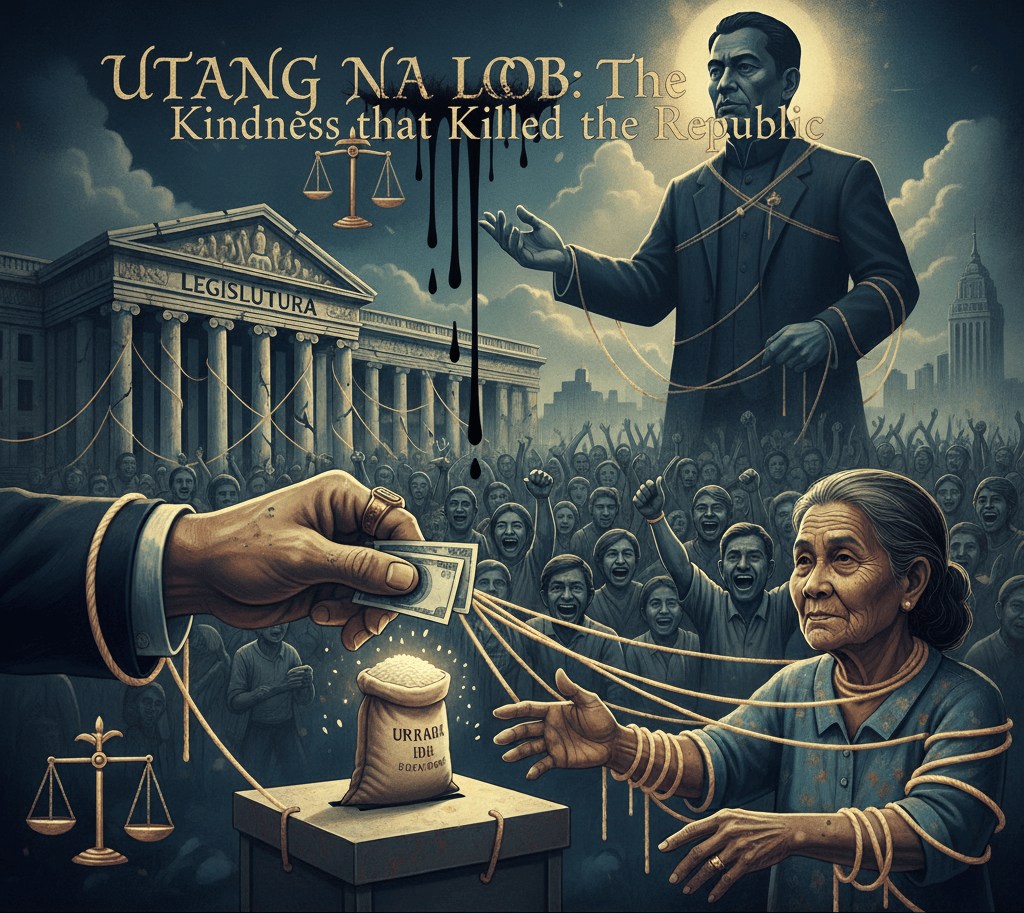
(You can download a pdf copy of this whole article here.)
Preface
This is not a history lesson. It is an autopsy.
For decades, Filipinos have been told that corruption is the fault of bad leaders—Marcos, Estrada, Arroyo, Duterte. Change the face, punish the thief, and the Republic will heal. Yet history keeps repeating itself: every reformer is swallowed, every revolution ends in disappointment, and every promise of “good governance” eventually dissolves into compromise.
The problem runs deeper. Corruption in the Philippines is not merely the theft of money; it is the theft of the Republic itself. It is the triumph of a moral economy where utang na loob—the personal debt of gratitude—overpowers virtus, civic virtue. It is the substitution of amicitia (personal loyalty) for fides (institutional trust). It is the slow corrosion of every branch of government, every election, and even the private conscience of the citizen.
This work is a five-part examination of that moral collapse.
Part I returns to the philosophical roots, tracing how the confusion of public trust with private debt has long haunted the Republic.
Part II explores how Marcos perfected this logic of patronage into a machinery of plunder.
Part III follows its spread into the legislature and the judiciary—institutions designed to restrain power but instead absorbed by it.
Part IV descends to the level of the citizen, asking why the Filipino voter, faced with the state’s weakness, still chooses the Patron over the Reformer.
Finally, Part V confronts the paradox of Leni Robredo—the reformer who tried to restore impersonal virtue, only to be undone by the same culture of gratitude that first lifted her into office.
This is not written to condemn, but to warn. Unless the chains of utang na loob are broken—at the dinner table, in the barangay, in Congress, and in the courts—the cycle will not end. Faces will change, scandals will fade, but the betrayal of the Res Publica will endure.
Only when gratitude yields to justice, and kindness to duty, can the Republic be reborn.
Author’s Note
This work began as a question I could not shake: Why does corruption in the Philippines always survive reform?
I have lived through enough administrations to know that every promise of change eventually sounds the same—sincere, hopeful, and doomed. Each new president comes with the language of renewal, only for the familiar patterns to return: the same faces in new offices, the same debts disguised as alliances, the same Republic trading loyalty for law.
Somewhere in that repetition, I began to suspect that what we call corruption is not simply a failure of governance, but a failure of affection—a distortion of how we give and receive gratitude. We were raised to say thank you for every act of help, to honor loob as the heart of being Filipino. But what happens when that loob—that deep sense of personal debt—is absorbed into politics? What happens when every act of governance must pass through the language of favor?
This series was my attempt to find the answer, or at least name the sickness. It was written slowly, between the noise of daily politics and the quiet of reflection, while watching the same cycle play out—new slogans, new scandals, old logic.
I do not write as an academic, nor as an activist, but as a citizen trying to understand why our kindness keeps betraying us. This is not a call to cynicism. It is an act of mourning, and perhaps, in the end, an act of faith—that somewhere beyond this long history of favors and debts, the Republic might still remember how to be free.
I. The Fatal Flaw — Ancient Warnings on Public Trust and Private Debt
How did we end up here?
The latest scandal over corruption in flood control projects is dispiriting, but hardly surprising. The names change, the figures grow, the outrage repeats—but the plot remains the same. Each cycle of revelation and amnesia reveals not merely administrative failure but a deeper moral corrosion. We speak often of greed, yet rarely of gratitude. We denounce the crime, yet seldom the culture that makes it feel inevitable.
This essay asks a simple but unsettling question: What if corruption in the Philippines endures not because of wickedness alone, but because of goodness misplaced? What if our Republic’s sickness lies not in malice, but in kindness—specifically, in the moral logic of utang na loob, the debt of gratitude, when transposed from private virtue into public life?
The Ancient Problem of Moral Allegiance
Every republic contains within it a flaw so intimate that it masquerades as virtue: the temptation to turn public duty into personal loyalty. From the earliest reflections on politics, philosophers warned that the gravest danger to civic order would not come from external enemies, but from within—from the moment citizens begin to confuse the state with the self.
In the Roman Republic, virtus—civic virtue—was the animating principle of citizenship. It required not merely courage but self-restraint, a constant subordination of private interests to the common good. The Roman citizen was bound by fides (trust) to the Res Publica, the public thing. To fail in office was dishonor; to use office for private gain was sacrilege.
Cicero, writing in De Officiis, saw this tension as the central ethical problem of the Republic. He argued that what is honestum (morally right) and what is expediens (expedient) could never truly conflict—for nothing that betrays virtue can serve the public good. His gravest warning was against those who placed amicitia (personal friendship or alliance) above fides publica. In his view, governing based on loyalty instead of justice was a self-destructive act for the state; he famously stated that a person who prefers the claims of a friend over the Republic is a friend to neither the individual nor the state itself.
Aristotle diagnosed the same pathology in another register. He called it pleonexia—the desire to have more than one’s fair share, whether of wealth, honor, or power. For Aristotle, justice is the mean between pleonexia (grasping) and loss; the corrupt man is one who takes more than what is owed. When this appetite infects rulers, it transforms the polis into an oligarchy of favors.
These warnings, though ancient, describe with uncanny precision the moral architecture of modern corruption: when obligation owed to the whole is subordinated to the claims of the particular—the friend, the ally, the benefactor.
From Civic Debt to Moral Debt
The distinction between two kinds of obligation is critical:
- Transactional Debt (aes alienum) is finite, legal, and extinguishable. It ends upon repayment. It is the foundation of contract, the basic form of equality under law.
- Moral Debt, by contrast, is infinite. It cannot be repaid without remainder. Gratitude binds the receiver to the giver not through law, but through conscience; it seeks reciprocity in loyalty, not equity in exchange.
In the Philippine moral vocabulary, utang na loob—literally, a “debt from within”—belongs firmly to the second kind. It is among our most exalted virtues. It shapes kinship, friendship, and community life. It is what allows the Filipino to remember kindness, to prize relational continuity over impersonal exchange. But when carried into politics, it turns lethal.
The danger arises precisely at the moment the public servant—whose only legitimate debt is to the Republic—accepts or internalizes a private debt of gratitude. The moral logic of reciprocity, admirable in private life, becomes incompatible with the impartial logic of law. The first demands personal loyalty; the second forbids it. Between these two, allegiance fractures—and it is always the Republic that loses.
The Filipino Mutation of Loyalty
Nowhere has this tension been more consequential than in the modern Philippine state. What began as a cultural virtue of kinship has metastasized into a political operating system. Under Ferdinand Marcos, utang na loob became institutionalized as statecraft. Power flowed not through constitutional channels, but through debt networks—personal, familial, and financial. Cronyism was not a deviation from the system; it was the system. The redistribution of national wealth was justified not as theft but as utang na loob repaid—to allies, donors, and loyalists.
The tragedy, however, did not end in 1986. The fall of Marcos dismantled a dictatorship but left untouched the moral economy that sustained it. Succeeding administrations, even reformist ones, operated within the same logic: favors disguised as public service, appointments as repayments, political loyalty as the currency of governance.
We have thus built not a meritocracy nor a republic of laws, but what might be called a Republic of Favors—a state continually reabsorbed into the affective ties it was meant to transcend. Justice becomes a favor granted, not a right upheld; governance becomes a performance of benevolence, not an exercise of duty.
The Theft of the Republic
Corruption, in this deeper sense, is not the mere embezzlement of funds. It is the embezzlement of allegiance—the diversion of civic loyalty into private channels of obligation. It is the quiet replacement of the Res Publica with the Res Privata, the privatization of the moral life of the state.
And so the question “How did we end up here?” finds its answer not in the crimes of individuals but in the collision of two moral worlds: the finite justice of institutions and the infinite debt of gratitude. When governance is built upon the latter, law becomes secondary, and every act of kindness becomes a transaction of power.
The argument that follows is not historical but philosophical: corruption is not a crime against property; it is a crime against the Republic’s moral structure. It replaces Virtus with Amicitia, Fides with Utang na Loob, law with loyalty.
Marcos did not invent this system; he simply gave it form. Until that form is broken—until we restore civic virtue as the highest allegiance—our Republic will remain a house built on borrowed trust.
The ancient warning still stands: when private debt governs public life, the state itself begins to die.
II. From Patronage to Plunder: The Marcos Era as the Zenith of Personalized Power
Perhaps the question that must be answered is: How did we start from where we are?
While political corruption is as old as the Philippine Republic itself, the regime of Ferdinand E. Marcos elevated utang na loob (debt of gratitude) from a cultural norm into the core operating principle of the state. During two decades of Marcos rule, the line between the public purse (Res Publica) and the private treasury of the ruling family was systematically erased. This was the moment Cicero’s warning came to life: the preference of personal amicitia (loyalty) over civic fides (trustworthiness) became the governing logic, displacing virtus (civic virtue) with a transactional system of absolute, personalized obligation.
Marcos understood that authority in a weak republic was never built on institutions but on emotion. He turned loyalty into a moral currency, and himself into its central banker. His genius—and his danger—lay in transforming utang na loob into a moral contract of obedience.
The Cult of the Strongman
Marcos’ self-presentation was more than vanity—it was ideology. He staged himself as a modern Caesar: soldier, scholar, savior. His medals—many fabricated—his bar-top rank, his long speeches laced with Latin and law, all built the image of a man of destiny. The myth of the “war hero” was propaganda, but it worked. It gave moral sanction to his claim that discipline required devotion, and devotion meant submission to him.
Power under Marcos was not bureaucratic; it was feudal. His symbolic case in point—his household plumber who became mayor, remembered locally as the ‘umbrella man’—was not absurd to him but the clearest expression of his personal, non-meritocratic rule. Loyalty was the highest qualification for public office. When his plumber became mayor, it sent a message to every soldier, governor, and bureaucrat: fidelity to Marcos outweighed competence.
By 1975, eighteen of the twenty-two generals of the Philippine Constabulary were from Ilocos, his home region. The military ceased to be a national institution and became an extension of the Ilocano loob—a fraternity bound by kinship and obligation. The same logic governed the bureaucracy: those who rose did so by grace, not merit.
Max Weber called this system patrimonialism—the state as the personal household of the ruler. Public office becomes private fiefdom; every promotion, every concession, every loan is a “gift” to be repaid in loyalty. What Cicero once warned against—the conversion of fides publica into private friendship—was completed under Marcos with ruthless efficiency.
The Machinery of Moral Debt
Cronyism under Marcos functioned as a state-sponsored engine of utang na loob. Access to national resources was conditioned not on merit or economic viability, but on loyalty to the First Family.
- Monopoly Grants. Exclusive control over key industries was handed to regime loyalists. Eduardo “Danding” Cojuangco seized the coconut industry through levies imposed on small farmers, turning collective suffering into a private empire. Roberto Benedicto monopolized sugar exports; Lucio Tan built a banking and tobacco empire under state protection. These monopolies were not economic strategies—they were instruments of moral control.
- Debt Bailouts and Subsidized Loans. Public funds were used to rescue failing ventures owned by friends and financiers of the regime. The Bataan Nuclear Power Plant, financed through massive foreign debt, became a monument to patronage disguised as progress. State banks underwrote luxury hotels for the 1976 IMF-World Bank meetings, showcasing the nation’s glamour even as the poor paid for it through taxes and inflation.
- Government Positions. Family members and loyalists occupied powerful, unelected offices. Imelda Marcos, as both Governor of Metro Manila and Minister of Human Settlements, presided over budgets larger than many departments combined. The children followed: Imee as national chair of the Kabataang Barangay and Assemblywoman, Bongbong as Governor of Ilocos Norte, and Irene, though holding no office, as an avatar of extravagance—her $10.3-million wedding and yacht party became public spectacle.
Each position, project, and privilege was framed not as a transaction but as a gift. To receive was to owe, to owe was to serve. Loyalty thus became the organizing principle of the Republic.
The Cultural Re-engineering of the Nation
Marcos knew that sustaining this system required more than fear or money; it needed belief. His Bagong Lipunan (“New Society”) was not simply a slogan—it was a moral revolution.
Through curriculum reforms, textbooks were rewritten to teach that obedience was patriotism, that national order was superior to personal freedom. History classes celebrated the “Revolution from the Center,” recasting Martial Law as an act of benevolent discipline. Civic education was stripped of the vocabulary of rights and replaced with the rhetoric of duty. In the New Society, freedom was a reward, not a right; gratitude replaced vigilance as the citizen’s chief virtue.
Marcos called this constitutional authoritarianism—lawful dictatorship. It was a perversion of legality itself: law was no longer the restraint of power but its justification. Lex (law) ceased to protect the citizen and instead sanctified the ruler’s will. Cicero’s harmony between honestum (the honorable) and expediens (the expedient) was broken; the useful once again devoured the just.
The Theater of Benevolence
If ideology worked in the classroom, performance worked in public. The regime mastered spectacle: the lavish state dinners, the imported royalty, the Hollywood stars. Imelda’s Cultural Center and the Coconut Palace were not buildings—they were sermons in marble, testaments to a ruler’s generosity.
In every disaster, sacks of rice bore the President’s face; relief trucks carried his name. The state itself was anthropomorphized—Marcos and Imelda were the Republic incarnate. The public learned to say thank you not to institutions, but to them. Gratitude replaced accountability.
This was the most insidious success of the Marcos era: citizens were trained to feel beholden to their own government. To criticize was to be walang utang na loob—ungrateful. The moral vocabulary of a nation was rewritten so that tyranny could feel like kindness.
The Legacy of the Household Republic
When the regime collapsed in 1986, what fell was only the family, not the structure they built. The logic of loob survived every revolution. Corazon Aquino’s administration restored democracy but could not undo its patronage scaffolding—Hacienda Luisita exposed how personal interest limits reform. Fidel Ramos relied on coalition politics rooted in loyalty. Estrada revived barkadahan populism; Arroyo institutionalized transactional loyalty in the bureaucracy; Duterte revived the strongman ethos of personal devotion.
Every leader since Marcos has lived within his architecture. Each inherited the same moral equation: power as favor, gratitude as obligation.
And so we return to the question: How did we end up here?
Marcos may have fallen, but the world he perfected did not. What collapsed at EDSA was the man, not the moral economy he built. The Republic still labors under obligations masquerading as gifts, loyalties dressed as governance, gratitude demanded in place of law.
This is the enduring legacy of the Marcos era—not merely the theft of billions, but the corruption of the very concept of the public. Until that structure is broken, history will not move forward. It will only circle back—new leaders, new scandals, the same betrayal of the Res Publica.
III. The Corrosive Web—Patronage and the Capture of Legislative and Judicial Power
But how far does this sickness go?
Montesquieu once warned that a republic dies not from invasion, but from the slow erosion of its own virtue. The separation of powers, he wrote, is not merely a constitutional device but a moral barrier: the self-restraint of each branch is the measure of a nation’s freedom. In the Philippines, however, that restraint has long been dissolved by the same acid that corroded the Executive — utang na loob. The conflict between amicitia (personal loyalty) and fides (institutional trustworthiness) has seeped into every chamber of governance, bending both the legislature and judiciary to the private gravity of obligation.
The Legislature as Marketplace of Gratitude
The legislature, designed to be the people’s forum, evolved into the Republic’s most elaborate patronage network. The pork barrel — an inheritance from the American colonial system — was reborn as the Countrywide Development Fund under Corazon Aquino, then rechristened as the Priority Development Assistance Fund (PDAF). The name changed with each administration; the moral logic never did.
Every project built with these funds — a bridge, a barangay hall, a scholarship — was not introduced as the state’s provision but as the legislator’s personal favor. “Tulong ko sa inyo ito,” they would say, as if the taxes that built those clinics were theirs to give. Each ribbon-cutting created two debts: constituents indebted to their representative, and representatives indebted to the President, who controlled the fund’s release.
What began as fiscal decentralization became moral subjugation. Congress turned into a warehouse of favors — the modern looban, where loyalty was bartered for budget.
Noynoy Aquino’s Disbursement Acceleration Program (DAP) revealed the pattern in broad daylight. Public funds were redirected to legislators who supported the administration’s key policies, notably the impeachment of Chief Justice Renato Corona. It was justified as “economic stimulus,” but everyone knew what it was: the conversion of appropriations into allegiance.
Then came the PDAF Scam, an exposé so vast it almost numbed the public. Senators Bong Revilla, Jinggoy Estrada, and Juan Ponce Enrile were indicted for plunder; others — Honasan, Legarda, Bongbong Marcos — were implicated but never charged. The machinery extended downward to the House: names like Marcoleta, Villanueva, and Zubiri surfaced in audit reports, linked to ghost projects and fake NGOs under Janet Napoles. Ten billion pesos disappeared into a black hole of fabricated assistance and recycled gratitude.
When the Supreme Court struck down PDAF as unconstitutional, the people rejoiced — briefly. The pork returned, only now in subtler forms: “insertions,” “allocations,” “congressional initiatives.” Even the acronyms changed — AICS, AKAP, MAIP — as though new names could cleanse old sins. But every time a lawmaker claimed a drainage canal, a livelihood program, or a relief truck as “his project,” the same moral debt was reborn.
In the end, what Congress truly legislated was not law, but loyalty.
The Judiciary and the Death of Impartiality
If the legislature was captured by pork, the judiciary was consumed by proximity — judges and justices bound by utang na loob to those who appointed them. The independence of the courts, once the Republic’s last fortress, now flickered like a candle in the wind of politics.
In 1982, when a bar exam scandal erupted involving the son of a Supreme Court justice, Marcos demanded the resignation of all fourteen justices, reappointing only those who proved “faithful.” It was a humiliation wrapped as discipline. From then on, the message was clear: even the highest court could be domesticated.
The pattern resurfaced decades later. Gloria Macapagal-Arroyo’s “midnight appointment” of Renato Corona in 2010 — a maneuver justified by a pliant Court — mocked the very Constitution it was meant to defend. The Court’s ruling that the ban on appointments did not apply to them was jurisprudence bent by gratitude.
Noynoy Aquino’s response only deepened the wound. He mobilized Congress to impeach Corona — not purely for corruption, but for political retribution. The trial exposed a judiciary no longer trusted, and a Congress too compromised to judge impartially. When Corona fell, it was not a triumph of accountability but the settling of accounts.
Aquino’s chosen successor, Maria Lourdes Sereno, was meant to symbolize reform. Instead, she became the next casualty of loob. In 2018, under Rodrigo Duterte, Sereno was ousted not by impeachment — the only constitutional means of removal — but by quo warranto, filed before her own Court. Justice Marvic Leonen called it “a legal abomination.” Justice Alfredo Caguioa described it as judicial suicide—“seppuku—without honor.” Sereno’s successor, Teresita de Castro, had voted for her removal and served barely forty-four days before retirement. The sequence was not mere coincidence; it was choreography.
Each Chief Justice owed her seat to the gratitude of another. Each President repaid a favor or avenged a slight. The Constitution became less a covenant than a contract of debts, amended not by law but by loyalty.
The Moral Collapse of Checks and Balances
In theory, these branches exist to restrain one another; in practice, they now conspire to survive together. Legislators shield the Executive in exchange for funds; the Executive shields the Legislature with appointments and protection; the Judiciary shields both when needed, bending doctrine to preserve the cycle.
The Republic thus becomes a closed loop of expediens (self-interest) and amicitia (personal alliance), where virtus (civic virtue) and fides (trustworthiness) are reduced to ornament. The law becomes not the voice of reason but the echo of favors.
Montesquieu warned that once citizens begin to obey persons rather than laws, liberty perishes quietly, without fanfare. The Philippines lives perpetually in that quiet: where a senator can thank a president for “understanding,” a judge can cite “prudence” to justify subservience, and a congressman can call his own vote an “act of conscience” while waiting for his project funds to be released.
And so I ask again: How did we end up here?
Perhaps the answer lies in this fatal irony: the very institutions designed to secure the rule of law have become instruments of its betrayal. Until the invisible chains of utang na loob are broken — until public service is no longer mistaken for personal kindness — the legislature will remain a marketplace of favors and the judiciary a theater of revenge.
Where law itself bends under loyalty, the Republic cannot endure.
IV. The Logic of the Client: Why the Filipino Voter Prefers a Patron to a Platform
But how far does this sickness reach?
In the preceding parts, we traced how the political elite—from Marcos to the present—weaponized utang na loob (debt of gratitude) to capture the executive, the legislature, and the courts. Yet the endurance of this system rests not in the palace or the courthouse, but in the barangay hall, the marketplace, the sari-sari store. The moral economy of gratitude survives because it is continually renewed from below. It is not imposed upon the people; it is sustained by them.
The logic of patronage thrives where the state is weakest. When public institutions fail to provide reliable services, the citizen turns not to the Republic but to the Patron. The failure of the state becomes the success of the political benefactor. Each unrepaired road, each understocked public hospital, each delayed aid distribution becomes an opening for personalized power to step in and claim what the state has forfeited.
The Rationality of Dependence
It is tempting to scold the Filipino voter for choosing the patron over the platform—but that would miss the deeper tragedy. For many, this choice is not irrational at all; it is the only form of security available.
When the system offers no certainty, the gift of the politician becomes a kind of insurance. A pack of noodles during calamity, a few thousand pesos for a funeral, a hospital referral for a sick child—these are not luxuries. They are lifelines. They may come from stolen public funds, but to the recipient, they arrive in moments when the state itself is absent. Gratitude, therefore, is not born of ignorance but of survival.
This is the cruel paradox of our politics: a rational act at the level of the individual creates a destructive outcome at the level of the nation.
Machiavelli observed that when survival is at stake, citizens will always choose expediens (the expedient) over virtus (civic virtue). In the Philippines, that law of necessity has hardened into culture. The utang na loob binds the poor voter to the rich patron, not as equals in a democracy, but as debtor and benefactor in a moral economy of survival.
The Weak State and the “Law of the Fish”
Kautilya’s Arthashastra warned that in the absence of an effective sovereign, society reverts to matsya nyaya—the law of the fish—where the big devours the small. This image describes the Philippine condition perfectly. The weak state leaves its citizens swimming unprotected in a sea of need, and so they swim toward the largest fish that promises shelter.
The Patron offers what the Platform cannot: immediacy. He speaks the language of the heart, not of policy; he gives relief today rather than reform tomorrow. The Reformer, on the other hand, offers abstractions—transparency, good governance, structural change—all noble, but distant. Between hunger and hope, the calculus of survival is unambiguous.
The poor vote not for the man they admire, but for the man who has already helped them. The ballot becomes a receipt of gratitude, not a judgment of principle.
The Social Sanction of Gratitude
Cultural pressure seals this arrangement. To reject a benefactor is not merely political; it is moral. To be branded walang utang na loob—ungrateful, shameless—is to be cut off from the moral community itself. In tightly knit barangays, this is social death: it means exclusion from the Patron’s network, from assistance, even from protection. Gratitude becomes both currency and leash.
Thus, elections resemble ritual repayment. A mayor who provided scholarships or funeral aid can count on votes as if they were debts maturing on election day. To vote otherwise would be treachery. As one voter in Bulacan once told a journalist, “Eh siya ang tumulong noong nasunugan kami. Paano ko siya hindi iboboto?” (“He helped us when our house burned down. How could I not vote for him?”)
In such a system, citizenship collapses into clientship. The citizen becomes a client who waits, not for justice or progress, but for kindness.
The 2022 Paradox
The 2022 presidential election exposed this logic in full view. Leni Robredo’s campaign, grounded in competence and institutional transparency, rejected the politics of patronage. Her pandemic initiatives were framed as public duty, not personal favor. Yet in a political culture that equates assistance with generosity, not accountability, that refusal cost her dearly.
Her rival, Ferdinand “Bongbong” Marcos Jr., inherited the opposite inheritance: dynastic loyalty, familial nostalgia, and the unbroken chain of loob owed to his name. Partnered with Sara Duterte, who embodied her father’s brand of personalist rule, they combined decades of inherited gratitude into a near-unstoppable force. It was not merely a campaign—it was the repayment of old debts.
In the end, Robredo offered virtus; Marcos offered expediens. The people, faced with two competing moral economies, chose the one they knew could feed them tomorrow.
The Tragedy of Rational Choice
Here lies the ultimate paradox of Philippine democracy: a people acting rationally within a broken system perpetuate the very system that keeps them broken. The Patron thrives on the weakness of the state, and every vote cast in gratitude weakens the state further. The cycle feeds on itself, generation after generation.
And so I ask again: How did we end up here?
Perhaps the answer is this: the Republic has been replaced not by tyranny, but by kindness—the kind that kills slowly, by teaching citizens to mistake favors for rights and loyalty for law. Until the citizen ceases to see himself as a client and begins again to see himself as a constituent, the Patron will always triumph over the Platform, and the Republic will remain trapped in its eternal exchange of gratitude and betrayal.
V. The Leni Paradox: When the Best of Intentions Is Trapped by the Debt of Gratitude
And so we end up here.
In this series, we have traced the slow corrosion of the Republic — from the ancient conflict between virtus (civic virtue) and utang na loob (debt of gratitude), to its institutional capture under Marcos, to its reproduction across the Legislature, the Judiciary, and finally, the citizenry itself. We now arrive at the paradox that completes this argument: that even the most virtuous of leaders, one who rejects the logic of patronage and seeks to govern by civic duty, cannot escape the moral economy that brought her into being.
This is the Leni Paradox — the tragedy of a reformer born within the very system she sought to transcend.
The Inherited Debt of Power
Leni Robredo’s story, often told as one of reluctant leadership and moral clarity, begins with an inheritance not of wealth or ambition, but of grief. Her entry into politics followed the sudden death of her husband, Jesse Robredo — a technocrat of rare integrity whose public service embodied everything the Republic ought to have been: competent, transparent, humane. In the wake of that tragedy, the nation’s collective sorrow transformed into a kind of civic obligation — a debt of gratitude owed to Jesse’s memory. That debt was transferred, almost reflexively, to his widow.
This pattern was not new. In 1986, Corazon Aquino ascended to power on the same moral logic. The assassination of Benigno “Ninoy” Aquino Jr. created a national utang na loob — a debt of blood and justice — which propelled his widow to the presidency. That revolution, while historic, was itself born of a moral transaction. The people sought redemption through gratitude, not reform through structure.
But debts, even moral ones, demand repayment. Cory Aquino’s administration, bound by the moral contract that birthed it, could not sever its ties to patronage. The pork barrel persisted. Dynasties thrived. The revolution that began in moral fervor ended in institutional compromise.
Three decades later, history repeated itself. Leni Robredo, like Cory before her, entered politics through mourning — elevated not by the machinery of a party or the weight of policy, but by the emotional gravity of loss. Once again, tragedy became the conduit of legitimacy; once again, the Republic mistook personal virtue for systemic change.
The Attempt to Break the Cycle
Yet within that inherited debt, Robredo attempted something radical. As Vice President, she treated her office not as a stage for personal generosity but as an instrument of institutional restoration. Through the Angat Buhay program, she redefined assistance as partnership, not patronage. She refused to brand government aid with her name, ensuring that the credit belonged to the office, not the person.
In philosophical terms, Robredo sought to convert amicitia (personal loyalty) into fides (institutional trust). It was a deliberate counterattack against the moral economy of utang na loob — an effort to teach the citizen that help is a right of citizenship, not a favor owed to the powerful.
Her governance style was almost bureaucratic in its moral intent: calm, methodical, precise. She was the anti-patron, and that was her revolution.
But revolutions waged against culture rarely succeed in one lifetime.
The Weight of the Patron
The 2022 election exposed the limits of virtue in a society still governed by gratitude. Robredo’s campaign, defined by competence and institutional trust, confronted an opponent who embodied the opposite: dynastic loyalty, inherited amicitia, and the familiar warmth of personal power. The Marcos-Duterte tandem did not merely campaign — they collected debts. They summoned decades of loob, both inherited and renewed, binding together the emotional economies of two powerful families into a single moral empire.
Against that tide, Robredo’s message of reform found little purchase. The Republic, still captive to the logic of the Patron, chose familiarity over faith, immediacy over principle. Once again, expediens triumphed over virtus.
The result was not merely a political defeat but a civilizational verdict: the people remain chained to the moral order of personal debt. Even the most honest leader cannot govern a people still beholden to patrons rather than to the Republic.
The Deeper Diagnosis
We must, therefore, be clear. Corruption in the Philippines is not primarily a legal or criminal problem; it is a moral-structural one. It persists because it is nourished by a culture that confuses kindness with duty, gratitude with accountability, loyalty with law.
Our institutions were built upon Western blueprints but operate within a distinctly Filipino moral economy — one where utang na loob colonizes the public sphere. Every transaction, from the barangay to the Senate, is filtered through the question: Kanino ka may utang na loob? (“To whom do you owe your gratitude?”)
Until that question loses its political relevance, no reformer, however pure, can redeem the system. The system itself ensures that every act of governance is interpreted not as institutional function but as personal favor. Thus, even virtue becomes trapped — weaponized by the very moral logic it seeks to dismantle.
The Reconstruction of the Republic
If the disease is moral, the cure must be moral too. The Republic cannot be rebuilt through charisma; it must be reconstructed through education, civic practice, and the slow cultivation of impersonal trust.
This begins not in Malacañang, but in the smallest units of moral instruction — the home, the classroom, the barangay hall. The antidote to utang na loob is civic consciousness: the understanding that the state exists not as a patron, but as the organized expression of collective duty.
We must teach the next generation to ask: Why do we thank politicians for what our taxes paid for?
We must normalize the act of questioning — of demanding receipts, budgets, and public audits — as the highest form of gratitude to the Republic itself.
In time, as that moral awareness takes root, the social stigma of being called walang utang na loob will fade. In its place will rise a new honor: being loyal only to the public good.
The Instruments of Liberation
But moral reform must walk hand in hand with institutional change. Two reforms stand as the immediate preconditions for any real transformation:
- An Anti-Dynasty Law — for as long as bloodlines can inherit power, amicitia will always defeat fides.
- The Abolition of Budget Insertions and Pork Barrel Variants — for as long as public funds can be dispensed as personal gifts, utang na loob will remain the true currency of politics.
These are not mere technical adjustments; they are acts of emancipation. They strike directly at the twin roots of patronage: blood and money.
The Long War Ahead
Still, laws alone will not suffice. The longer battle is cultural — fought in whispers, classrooms, dinner tables, and elections. Every time a voter chooses platform over patron, every time a citizen demands accountability rather than mercy, a chain of utang na loob is broken.
This is how nations are reborn — not by saviors, but by citizens who have unlearned the language of debt.
The Final Lesson
The lesson of the Leni Paradox is inescapable: no single leader, however sincere, can redeem a people still bound by gratitude to power. Virtue without structural reform is tragedy. Integrity without institutional transformation is martyrdom.
The Republic will not be saved by another Cory or another Leni. It will be saved only when the people themselves reject the politics of loob and embrace the politics of law.
Until then, every reformer will fail, every republic will fall.
But when we finally sever these moral chains — when aid becomes right, when gratitude yields to justice, when the citizen ceases to bow before the patron — then, and only then, will we be free.
And in that moment, the Republic will finally become what it was meant to be: not an inheritance of gratitude, but a covenant of virtue.
Epilogue
The Republic of Favors
It always starts the same way—after the storm, after the flood, or, as in Cebu a few weeks ago, after the earth shakes. Cameras arrive, officials descend, and once again the Republic takes human form.
When Sara Duterte came with her convoy of relief trucks, the crowd cheered. People took selfies beside the tarpaulin that bore her name. Online, the comments were predictable: “She really cares. We will remember this.”
A few hours earlier, Bongbong Marcos had also visited. He surveyed the damage, issued orders to DSWD and DPWH, and directed immediate assistance. But he came empty-handed, at least in the visible sense. No sacks of rice with his face, no photo ops with plastic-wrapped goods. So to many, it seemed as though he did nothing. The bureaucracy may have moved, but the people did not feel it.
This is how utang na loob survives—not in policy, but in perception. The Vice President’s act looked like malasakit; the President’s act looked like paperwork. Both helped, but only one appeared to care. And in the moral economy of gratitude, what looks like kindness always outweighs what actually works.
At the barangay level, this arithmetic defines everyday politics.
In Barangay Camangaan, Pangasinan, a small sari-sari store sits across a muddy road still lined with sandbags from last month’s flood. A tricycle driver leans on his handlebar, watching the news from a small TV.
“Si Mayor, kahit papaano, may tulong,” he says. “’Yung isa, puro salita lang.”
The storekeeper nods. “’Pag may kailangan ka sa ospital, si Mayor pa rin ang lalapitan. May koneksyon sa doktor. ’Yung mga taga-national, hindi mo naman makausap.”
Just down the street is the new drainage canal—finished with great fanfare, funded by a multi-million peso flood control project. Two weeks after the ribbon-cutting, the same street went underwater. The concrete cracked; the culverts clogged with debris. Neighbors joked that it was “built with utang na loob instead of cement.” Everyone laughed, but no one filed a complaint.
“At least may ginawa,” the barangay captain said with a shrug.
The contractor, a known campaign donor, even dropped by with bottled water and noodles when the next flood came. The people were grateful; they cheered.
In that small exchange—between a flooded street and a box of instant noodles—the Republic is lost. Gratitude blurs accountability. Corruption hides behind kindness. And every disaster becomes another chance for the politics of benevolence to renew itself.
Politicians know this instinct better than anyone. They speak the language of loob fluently. They understand that in a country where the state feels distant, kindness is currency. So they make every act of governance look personal: relief goods labeled “from my office,” bridges named after families, scholarships credited not to institutions but to individual patrons.
They don’t need to reform the system—they only need to perform compassion.
The result is a Republic where favors replace rights. Citizens are trained to expect gifts, not governance; to thank the benefactor, not the institution. And when gratitude becomes the measure of leadership, corruption no longer offends—it endears.
It’s the same logic that built Camangaan’s broken canal. The same impulse that makes voters remember the Vice President’s rice trucks more than the President’s executive orders. What is visible is valued; what is systemic is invisible.
And so the flood returns—sometimes from rain, sometimes from politics. The waters rise, the people wade, and yet, when asked whom they will support, the tricycle driver smiles and says,
“Eh, si Mayor, kahit papaano, may tulong.”
That small sentence contains the entire history of our politics: the kindness that replaced justice, the favor that outlived the Republic.
The cycle will not break until gratitude itself is redeemed—until we learn to thank not the hand that gives, but the system that works. Until then, utang na loob will remain both our comfort and our curse: the debt that binds us together even as it keeps us from ever being truly free.
And so the ancient warning returns, echoing from Cicero’s republic to our own islands:
When private debt rules public life, virtue withers, and the state begins to die.
Unless we learn, at last, to keep the two apart, the floods will keep coming—and every act of kindness will continue to drown the Republic it means to save.
Colophon
Utang na Loob: The Kindness That Killed the Republic was written between the silences of memory and the noise of the present. It began as an attempt to understand a nation not through its laws, but through its habits of affection—the quiet exchanges, the small debts, the courtesies that bind power and loyalty together.
Each essay began as argument and ended as elegy—for the Republic as an idea, and for those who keep trying to make it real. The names change, the titles shift, but the story remains the same: a country forever weighing kindness against justice, favor against right, gratitude against duty.
In tracing that story—from Marcos to the new reformers—the work returned to one truth: the Filipino’s tragedy is not the absence of goodness, but its captivity. Utang na loob was once the moral thread that held families and communities together; somewhere between colonization and corruption, it was turned into the scaffolding of power. What once humanized our politics came to hollow it out.
If these essays unsettle more than they comfort, perhaps they have done their work. Reflection, like reform, begins in discomfort. To study utang na loob is not to reject who we are, but to mourn what it has become—to see how affection, unexamined, hardened into the architecture of our undoing.
So may this be read not as lament, but as a record of hope—the hope that the same kindness which once killed the Republic might also be the kindness that revives it. If utang na loob once bound us to persons, perhaps it can yet bind us to principle. If it once blinded us with gratitude, perhaps it can yet open our eyes to grace.
The Republic may have been betrayed by its own heart. Yet it is through that same heart that it may learn to live again—when kindness no longer demands loyalty, but service; when gratitude no longer buys silence, but calls for justice.
And perhaps then we will remember: love of country was never about the favor returned, but the good preserved.

