Atty. Bernard D. Bandonell | 21 May 2025
(This is an 18-minute read article. You can download a PDF copy of this article here.)
Abstract
This article interrogates the persistent phenomenon of political dynasties in the Philippines through the dual lens of constitutional law and political philosophy. Despite the 1987 Constitution’s express mandate to prohibit dynastic politics, legislative inaction has allowed the entrenchment of familial power in both national and local governance. Drawing on Kantian ethics, Michael Sandel’s communitarian critique, and emerging democratic theory, the piece explores the normative failure of institutions that tolerate power without merit and silence in the face of constitutional imperatives. Anchored in contemporary events — including electoral trends, regionalism, and the return of familiar political names — it examines the contradictions between democratic ideals and political realities. It also reflects on the evolving political consciousness, particularly among younger voters, and how this shift opens new space for reform. The article argues that while legal tools remain underutilized, the path forward lies not only in institutional redesign but also in reawakening the moral imagination of the legal profession and citizenry alike. Ultimately, it calls for a reinvigorated commitment to democratic values that is not nostalgic, but transformative.
I. The Shape of Power
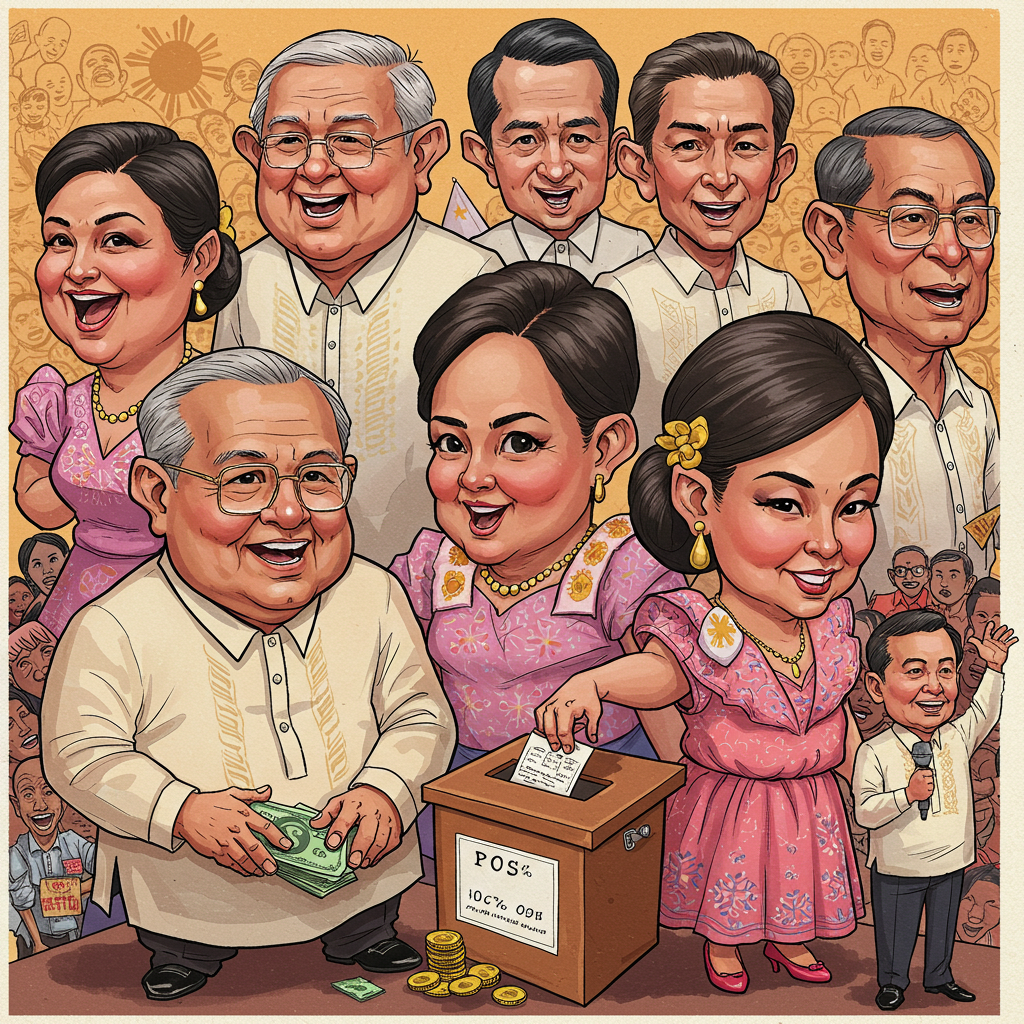
Every election cycle in the Philippines feels like déjà vu. The same names—familiar, powerful, dynastic—appear on the ballot as if political office were not a public trust, but private inheritance. In the last national elections, a pair of brothers vied for Senate seats—only one made it through. A matriarch, attempting to extend her family’s 30-year hold on a congressional seat, finally lost. For a moment, it felt like a shift.
But that feeling was fleeting.
Elsewhere, the machine ran as usual. The Senate now includes four pairs of siblings. In various cities and provinces, members of three generations from the same families each won different local posts, as if democracy itself had bent around family trees. This isn’t the exception. This is the pattern—not a flaw, but a feature.
The Constitution says otherwise. It speaks of equal access to public service, of prohibiting political dynasties. But more than three decades on, that promise remains empty—no enabling law, no real challenge to the status quo. This failure isn’t an accident. It is self-preservation masquerading as deadlock.
This impasse raises an important jurisprudential question: what happens when constitutional aspiration is held hostage by legislative inaction? And what is the role of legal professionals—judges, scholars, advocates—when the law refuses to do what justice requires?
The problem is not merely electoral. It is philosophical. Representation in a republic presupposes a kind of moral equality—a belief that no one enters public service with a superior claim by bloodline alone. Kant would frame this as a matter of autonomy and universality: a just political order must be capable of justification to all, not just to those with inherited access.
Dynastic rule, in contrast, institutionalizes exclusion. It recycles power within closed networks, frustrates meaningful competition, and slowly erodes public trust. Even when dynastic candidates prove competent—and some certainly do—their merit cannot erase the structural imbalance their presence reinforces. They win in a rigged game. Their success is part of the problem.
Yet something is stirring. Among younger voters especially, there’s a growing impatience with the inevitability of surnames. The occasional triumphs of first-time candidates, unbacked by dynastic machinery, are flickers of resistance. They are not yet a wave—but they are a warning.
We cannot afford to be lulled by isolated defeats of political clans. These are not signs of systemic change; they are invitations to ask harder questions. Who gets to run? Who gets to win? And why do the answers always circle back to the same families?
This article begins from that unease. It does not argue that every political heir is illegitimate or unworthy. But it confronts the deeper injustice of a system that renders them nearly impossible to unseat. Power, once consolidated, does not disperse on its own. It must be questioned. It must be challenged.
Because, in law as in philosophy, when silence becomes a strategy—and inertia becomes complicity—the burden of breaking the cycle falls on all of us.
II. Constitutional Silence
Article II, Section 26 of the 1987 Philippine Constitution contains a promise: “The State shall guarantee equal access to opportunities for public service, and prohibit political dynasties as may be defined by law.” At first glance, the language seems assertive. But this clause, despite its moral posture, has remained dormant for nearly four decades. It is a provision that gestures toward reform without ever requiring it.
The key phrase—“as may be defined by law”—has served as a convenient exit ramp. In theory, it delegates the task of giving life to the prohibition to Congress. In practice, it defers justice to the very body most compromised by its enactment. Expecting meaningful reform from legislators steeped in dynasty is like asking a turkey to plan Christmas dinner: the outcome is predictable. The result is a constitutional commitment held hostage by legislative inertia—if not outright defiance.
From a doctrinal standpoint, the silence is jarring. Constitutional rights are typically self-executing or made justiciable through enabling legislation. But when a right is structurally dependent on legislative good faith—and that good faith is absent—the legal system enters a gray zone. The judiciary, often citing the political question doctrine, hesitates to intervene. Congress, meanwhile, remains immobile. The silence becomes systemic.
This is where jurisprudence and philosophy collide. At what point does constitutional inaction become constitutional failure? When the Constitution empowers the legislature to define a prohibition—but the legislature benefits from the absence of that definition—the democratic contract is fractured. The social contract presumes reciprocity: that power is entrusted to representatives who, in return, serve the public good within constitutional limits. But when lawmakers refuse to legislate a mandate that threatens their own power, that trust is broken. The rules are no longer made in the name of the people, but in service of those already in control.
At that point, the law no longer functions as a constraint on power—it becomes its accomplice. And when this posture becomes the norm, the very idea of constitutional government begins to erode.
Kant reminds us that freedom is not the absence of constraint, but the presence of laws one gives to oneself. If political dynasties operate without legal boundaries—if they perpetuate themselves through the very structure meant to contain them—then we are not free in the republican sense. The constitutional silence becomes a form of passive injustice: it allows inequality to persist under the guise of procedural propriety.
This silence is also reinforced by culture. Political families invoke the language of service, continuity, and familiarity. They present dynastic succession as organic, even benevolent. And because the Constitution has offered no counterweight, these narratives go largely unchallenged in law.
But the deeper question remains: how can a republic sustain legitimacy when the core premise of equal access is compromised by systemic inheritance?
For legal professionals, this question is not rhetorical. It invites a revisiting of how we understand judicial duty in the face of institutional failure. The 1987 Constitution expanded the scope of judicial review through Article VIII, Section 1, granting courts the authority to determine not just the legality, but the grave abuse of discretion amounting to lack or excess of jurisdiction by any branch or instrumentality of the government.
That language was not ornamental. It was inserted precisely because of the historical memory of a time when deference became complicity. Under this view, legislative inaction—particularly when it undermines an express constitutional directive—may itself constitute a form of grave abuse. Not in the traditional sense of overreach, but in its abdication of duty so total it borders on sabotage.
This framing repositions the issue. The absence of an enabling law on political dynasties is no longer merely a political oversight—it becomes a legal dereliction, one potentially justiciable if properly framed.
This question is not novel. In jurisdictions with robust constitutional traditions, courts have, in certain cases, intervened when legislative inaction threatens to undermine core constitutional guarantees.
In the United States, for instance, the judiciary has historically exercised restraint in cases of legislative inertia. Yet there are landmark exceptions where inaction itself was deemed constitutionally impermissible. Reynolds v. Sims (1964) is instructive. There, the U.S. Supreme Court held that grossly malapportioned legislative districts—left uncorrected by state legislatures—violated the Equal Protection Clause of the Fourteenth Amendment. Writing for the Court, Chief Justice Earl Warren famously declared that “legislators represent people, not trees,” and the Court intervened to enforce fairer representation precisely because the legislature had refused to act. The case stands for a critical proposition: that judicial power may be properly exercised when legislative inaction amounts to a denial of constitutional rights. While Reynolds was not a challenge against the legislature as a body, it underscores a broader principle: that constitutional silence, when weaponized, can become justiciable harm.
In Brown v. Board of Education (1954), and more forcefully in Cooper v. Aaron (1958), judicial intervention went beyond mere interpretation; it became enforcement, following legislative or executive resistance to desegregation. These cases marked moments when the U.S. Supreme Court recognized that constitutional rights cannot be left at the mercy of political will.
These foreign experiences, while rooted in different legal traditions, affirm a shared principle: that constitutional rights cannot depend entirely on legislative will. When delay or neglect erodes democratic commitments, judicial passivity is not neutral—it becomes consent.
In the Philippine context, the constitutional grant of judicial power under Article VIII, Section 1 is broader than its U.S. counterpart. The phrase “grave abuse of discretion amounting to lack or excess of jurisdiction” was not decorative. It was a deliberate constitutional correction—an institutional response to the judiciary’s past deference under authoritarian rule. Its purpose was to ensure that inaction, whether passive or willful, by any branch of government would no longer be a shield against constitutional accountability.
Congress’s persistent refusal to define political dynasties, despite an express constitutional directive, may well rise to that threshold. If the practical effect of this inaction is to concentrate power in the hands of a political class—thereby denying others meaningful opportunity to compete—it implicates not only the principle of equal access but the guarantees of due process and equal protection under Article III. In Angara v. Electoral Commission (1936), the Court held that constitutional guarantees are binding on all branches and enforceable through judicial review. And in Reynolds v. Sims (U.S., 1964), legislative inertia in correcting malapportionment was found to violate the Equal Protection Clause because it structurally disadvantaged certain voters.
Taken together, these principles support a modest but principled judicial role. While courts cannot compel Congress to legislate, they are not powerless in the face of constitutional neglect. A declaratory judgment, recognizing that persistent inaction has hollowed out a constitutional mandate, would not overstep into policymaking. Rather, it would mark the boundary between legal aspiration and legal failure. Such a ruling becomes less about prescribing remedies and more about restoring clarity—affirming that constitutional silence, when it breeds inequality, is itself a form of injury. It would not resolve the problem, but it would give it shape—and in doing so, offer the public a sharpened tool with which to demand change.
III. Structures of Power
The persistence of political dynasties in the Philippines cannot be understood solely in terms of constitutional design or legal gaps. It must be examined as a structure—an ecosystem of power that is legal, cultural, economic, and moral all at once. It is not simply a question of who holds office, but how that office is made accessible, sustained, and justified across generations.
In theory, democracy is a rotating stewardship. In practice, power in the Philippines is often inherited, not earned. While elections are held regularly, their outcomes are disproportionately shaped by families with long-standing control over local economic resources, social networks, and patronage machinery. This control forms what Amartya Sen might describe as a “capability deprivation”—not in terms of income, but in the absence of real political choice.
And this deprivation is not always externally imposed. It is internalized.
At the local level, the Philippine voter navigates elections not just through ideology or policy but through deep-seated notions of kinship, familiarity, and obligation. Utang na loob (debt of gratitude), delicadeza (a sense of propriety), and personal loyalty blur the line between public service and personal favor. As a result, voters often support political families out of a sense of relational debt, not public conviction.
Layered onto this is the strong current of regionalism. Filipinos identify first by locality, then by nation. Loyalty to a kababayan—a fellow native of one’s province or region—often outweighs broader considerations of competence or reform. Political figures exploit this cultural trait, emphasizing local roots and dialects, even when their governance record is ambivalent or hollow. This helps explain why political families thrive: they are not simply seen as politicians, but as extensions of community identity.
This regional psyche is not inherently problematic—it reflects the archipelagic and pluralistic nature of the country. But in the context of weak political institutions and an uneven educational landscape, it tends to reinforce political monopolies rather than challenge them. Dynasties thrive in such terrain, not by force, but by default.
Here, law and philosophy intersect again. If law is meant to structure freedom, and politics is the space where freedom becomes action, then dynastic politics represents a hollowing out of both. It is not tyranny by imposition, but a subtler form of domination: the appearance of choice without its substance. As Kant would argue, autonomy requires more than the formal right to choose—it demands the conditions that make meaningful choice possible.
From a legal standpoint, the structure of power that sustains dynasties cannot be dismantled by legislation alone. It demands a cultural reckoning—an interrogation of how we define leadership, loyalty, and legacy. And yet law must still lead, because when left entirely to culture, the status quo protects itself.
Thus, the challenge is not simply prohibiting dynasties, but reimagining political merit. Who deserves to lead, and why? What should qualify one for power beyond lineage or name recognition? These are not just questions for scholars or lawmakers, but for a citizenry in search of dignity, not dependency.
The structure of power in the Philippines is deeply embedded—but not immovable. Signs of electoral maturity, especially among younger voters, suggest that a rebalancing may be underway. But structures do not collapse on their own. They are unmade by conscious acts of refusal, of questioning, of choosing differently—not just once, but consistently.
And that is where the work truly begins.
IV. Awakening Electorate
The story of Philippine politics has long been one of endurance—not of ideology or institutions, but of families. And yet, every so often, a fracture appears. A result defies expectation. A narrative begins to unravel. That moment, however brief, signals possibility.
In the recently concluded elections, familiar patterns held in many localities. Dynasties retained their grip in municipal councils, provincial boards, and congressional districts. But at the national level, a different current was felt. Celebrity candidates failed to capture the same magic they once did. A number of political heirs lost their bids, despite full machinery and name recognition. For once, the “inevitable” was not inevitable.
What explains the deviation?
Observers point to the generational shift in the electorate. Millennials and Gen Z voters now comprise a majority of registered voters. But this is more than a demographic fact—it’s a political force. These voters grew up in the shadow of EDSA, but without the same reverence for it. They inherit a democracy not as a sacred triumph, but as a broken promise. Their engagement is born not of nostalgia, but of frustration.
Unlike the generations before them, this cohort is not as easily moved by patronage, surnames, or song-and-dance campaigns. They are more digital, more issue-driven, and less beholden to traditional institutions. Their political education has not come from textbooks or rallies, but from threads, podcasts, vlogs, and viral takedowns of public officials. It’s messy, sometimes misinformed, but undeniably alive.
As political scientist Julio Teehankee has long observed, dynastic politics in the Philippines is sustained not merely by institutional weakness but by a “path-dependent” political culture—one that normalizes the inheritance of power in the absence of meaningful party development and inclusive political education. But even Teehankee has noted signs of an emerging “generational disjuncture”—a quiet resistance that disrupts the reproduction of elite power, particularly among urban youth and first-time voters.
This political awakening is not yet a revolution—it’s uneven, and vulnerable to co-optation. But it signals a growing discomfort with the status quo. And more importantly, it signals memory. Not the mythologized memory of revolutions, but the lived memory of corruption, floodwaters, traffic, bad governance, broken systems—accumulated over years, not centuries. Memory, as Hannah Arendt noted, is a precondition for responsibility. One must remember in order to judge, and judge in order to act.
Yet memory alone is not enough. What follows must be moral imagination. To question why we normalize dynasties. Why we dismiss competence in favor of charisma. Why we expect so little, then express shock when so little is delivered. The younger electorate appears to be asking these questions—and while their answers are not yet coherent, the act of asking already breaks the pattern.
But dynasties, long practiced in the art of survival, are not static targets. They do not merely resist change—they evolve with it. Power, when threatened, learns to disguise itself. Increasingly, political families are fluent in the language of reform. They speak of accountability, youth inclusion, even anti-dynasty laws—while their surnames remain stamped across entire ballots. Just days after the most recent elections, a powerful figure—his family fresh off a near-total sweep—told the press he alone could deliver the long-delayed anti-dynasty legislation. It sounds contradictory, but it’s not. It’s a political tactic. By appropriating the rhetoric of reform, dynasts seek to confuse the issue, blunt public outrage, and rebrand themselves not as barriers to reform, but as its unlikely champions. The goal is not reform, but reinforcement—maintaining control by appearing to question it.
In this light, we begin to see the outlines of a turning point—not a climax, but a pivot. Not an upheaval, but a redirection. The challenge now is whether the institutions, the law, and those who interpret and teach it, are ready to meet that shift with clarity, courage, and commitment. Because an awakening, once ignored, quickly fades. But if nurtured, it becomes movement.
V. Moral Contradiction
A republic built on the promise of equality, yet ruled—election after election—by a handful of surnames. A Constitution that guarantees popular sovereignty, yet leaves unchecked its quiet subversion. These are not mere inconsistencies; they are contradictions that cut to the core of the legal order.
What does it mean for the law to declare that public office is a public trust, while allowing that trust to be handed down like an heirloom?
The persistent inaction of Congress—dominated by the very dynasties the constitutional ban seeks to regulate—is not just a legal omission. It is institutional betrayal. The result is not merely a legislative gap; it is a moral breach.
In Oposa v. Factoran (1993), the Court recognized that some constitutional rights—especially those implicating intergenerational equity—require affirmative state action. That case affirmed not only a right, but a duty. By analogy, the constitutional prohibition against political dynasties cannot be treated as aspirational. It is directive. And yet, in stark contrast, no judicial intervention has ever succeeded in compelling Congress to act on it. The silence is not incidental. It is strategic—and deeply telling.
Could the Court act? It has before. In Mandanas v. Ochoa (2019), the Court recalibrated fiscal allocations to align with the constitutional design—a rare correction of longstanding legislative-executive deviation. And under the 1935 Constitution, Angara v. Electoral Commission (1936) established a foundational principle: that the judiciary is the final arbiter of constitutional meaning, even in the face of political resistance. Separated by decades and charters, both decisions affirm a shared premise: judicial silence, in the face of constitutional evasion, is not neutrality. It invites erosion.
So the question is not one of capacity, but of will. If the judiciary refuses to review what is arguably an institutional failure to implement a constitutional command, it risks complicity in the erosion of the rule of law.
In Kantian terms, this is an abdication of duty. Law, when stripped of its moral content and reduced to empty proceduralism, ceases to constrain power—it protects it. The categorical imperative would ask: could we will a political order where public office is monopolized by kinship? Where merit is performance, not principle? If we recoil from that vision—as most would—then the system we tolerate is not just imperfect. It is unjust.
Yet we normalize this contradiction. We call it tradition. We invoke voter choice, as though individual agency can overcome structural entrenchment. But as Ronald Dworkin reminds us, rights are trumps—not conveniences. A constitutional right is not a polite suggestion. It is a mandate.
The cost of tolerating this contradiction is civic atrophy. The public learns that laws can be beautifully written, hotly debated, and entirely ignored. That ideals may be etched into the Constitution, while political elites act with impunity. In time, the law no longer inspires. It performs. It no longer restrains. It excuses.
And that may be the most corrosive outcome—not that dynasties remain, but that citizens cease to believe that anything else is possible.
Jurisprudence, if it is to live up to its constitutional promise, must do more than interpret. It must clarify what the law demands. It must reject inertia disguised as restraint. And it must remind us that this contradiction—between what the law says and what it permits—is not theoretical. It is lived, daily, by citizens forced to choose among the children, siblings, and spouses of the same few families, under the watch of a legal system that remains, so far, conspicuously polite.
VI. From Memory to Movement
There’s a reason we build monuments. They are meant to anchor us in memory — to mark what we must not forget. The EDSA People Power Revolution was one such memory, cast not only in stone and asphalt but in the collective conscience of a nation that once stood still to reclaim its voice.
And yet, here we are.
The return of the Marcos name to the presidency — by election, not imposition — has unsettled many. But the deeper discomfort is not with the fact of his election alone. It is with what it represents: a nation that, over time, has permitted memory to fade into nostalgia, and nostalgia to calcify into acceptance. A democracy that forgets, forgets how to defend itself.
But let’s be clear: this is not about blaming voters. Democracy, after all, is not designed to be infallible — it is meant to be participatory. And participation can be shaped by time, culture, access, and historical revisionism. The problem lies not with the electorate alone, but with the institutions that failed to preserve the ethical weight of that memory — the law among them.
The 1987 Constitution was drafted with the trauma of dictatorship still fresh. It was, in many ways, an attempt to constitutionalize memory: to transform the horrors of authoritarianism into institutional safeguards. Term limits, decentralization, checks and balances, a strong Bill of Rights — and yes, the prohibition against political dynasties — were all meant to break the machinery of power consolidation.
But memory encoded without enforcement becomes ceremonial. A performative democracy, where elections are held regularly, but real choices remain limited by inherited power. Where rule of law is recited but rarely lived. Where the narrative of liberation ends at EDSA Shrine, but not in the barangay halls, municipal councils, and congressional chambers where dynasties thrive undisturbed.
Is it still the Marcoses’ fault that they returned to power? That’s the wrong question. The more difficult — and honest — question is: what did we fail to do, institutionally and culturally, in the decades that followed?
We failed to criminalize ill-gotten wealth comprehensively. We failed to protect the curriculum from revisionism. We allowed the law to be silent where it should have spoken loudly — in courtrooms, in classrooms, and in the halls of Congress. We turned EDSA into a symbol rather than a standard. And when symbols are not lived, they eventually lose their meaning.
This is not a call for mourning — it is a call for movement. Memory must be reanimated through civic agency and institutional repair. Not just during election cycles but in the slow, unglamorous work of political education, legal reform, and cultural reshaping. The promise of EDSA was never just about removing a dictator. It was about reclaiming moral authorship over our democracy.
The return of familiar names to power is not just a repeat of history — it is a test. Will we confront the uncomfortable truths about the gaps between law and justice, memory and action? Will we recognize that democracy is not what we inherit, but what we cultivate? We do not need monuments to remind us. We need movement — principled, grounded, and continuous. If EDSA was the prologue, the real story must now be written by those who have not forgotten, and who refuse to give up on the project of a republic worth believing in.
VII. Conclusion: The Work Still to Be Done
The endurance of political dynasties in the Philippines is not simply a failure of politics. It is a failure of imagination — of what our laws could have prevented, of what our democracy could have become, and of what citizenship could have demanded.
For nearly four decades, the constitutional promise to prohibit political dynasties has remained dormant, sidelined by a Congress peopled — quite literally — by those with the least interest in disrupting the very structure that keeps them in power. Inaction, in this context, is not neutrality. It is complicity.
But even that truth is incomplete. The deeper challenge lies not just in law or policy, but in the moral terrain that underpins them. When we treat political dynasties as inevitable, we surrender to the idea that public service is inherited, not earned. That political talent is a family heirloom. That governance is less about ideals, and more about access.
The contradiction runs deep. A constitutional order that claims to dismantle authoritarianism, yet tolerates hereditary control over elected office, lives with a fracture at its core. And fractures, when left unaddressed, eventually break open.
Still, there are signs — subtle but significant — that the old system is no longer operating without resistance. The youth vote is maturing. Voters are beginning to reject celebrity for substance. Civil society is reawakening. These are not yet victories, but they are signals. The conditions for reform are no longer theoretical.
And so the work begins — or continues, more accurately — not with sweeping gestures, but with deliberate insistence. That the constitutional silence on dynasties be broken through legislation. That courts interrogate inaction when it frustrates constitutional mandates. That education confronts power honestly, and that the legal profession no longer sees political neutrality as synonymous with disengagement.
The challenge ahead is not merely to correct a loophole in the system. It is to redefine the system itself, to reassert that democracy means more than casting a vote — it means building a culture where power is distributed, contested, and never taken for granted.
The law has not yet spoken decisively. But we can. And we must. Because if we do not hold our institutions to account, then we are not victims of dynastic rule — we are its enablers.
There is work still to be done. Let it begin with the courage to name the contradiction, the clarity to confront it, and the commitment to see it undone — not for the sake of nostalgia, but for the future that still deserves to be written.
_____________________
Further Readings:
This article gestures toward a deeper discourse on political inequality, institutional design, and democratic legitimacy. For readers who wish to explore the philosophical, legal, and political foundations discussed herein, the following works provide a valuable starting point:
- Immanuel Kant, Groundwork of the Metaphysics of Morals (1785). For the enduring insight that freedom is not the absence of constraint but the presence of laws one imposes on oneself—a moral foundation for republican self-rule.
- Michael Sandel, Justice: What’s the Right Thing to Do? (Farrar, Straus and Giroux, 2009). An accessible yet rigorous entry point into moral and political philosophy, especially on questions of merit, obligation, and institutional ethics.
- John Rawls, A Theory of Justice (Harvard University Press, 1971). A foundational text on justice as fairness, offering a normative framework for evaluating legitimacy in political and legal systems.
- Amartya Sen, The Idea of Justice (Harvard University Press, 2009). A compelling argument for understanding justice in terms of capabilities, democratic access, and practical reasoning—particularly salient in assessing unequal political opportunity.
- Hannah Arendt, The Origins of Totalitarianism (1951); Between Past and Future (1961). Arendt’s meditations on political memory, authority, and moral responsibility remain instructive for understanding democratic erosion.
- Julio C. Teehankee, Electoral Politics in the Philippines and related scholarship. A leading voice in the empirical and theoretical study of political dynasties, electoral reform, and institutional weakness in Philippine democracy.
- Antonio P. Contreras, selected essays on political dynasties and democratic consolidation in the Philippines. Offers grounded insights into how local political structures and patronage systems shape governance and representation.
- Reynolds v. Sims, 377 U.S. 533 (1964). A landmark U.S. Supreme Court decision enforcing the principle of “one person, one vote,” underscoring the judiciary’s role in correcting legislative imbalance.
- Cooper v. Aaron, 358 U.S. 1 (1958). An affirmation of the judiciary’s constitutional mandate to uphold rights, even against coordinated legislative or executive resistance

