Download pdf copy here.
ABSTRACT
The adoption of a permanent Senate rule permitting members to attend sessions and vote remotely via digital platforms — outside the context of any declared national emergency — raises a constitutional question of first impression under the 1987 Philippine Constitution. This article examines whether such a rule constitutes a valid exercise of the Senate’s plenary rulemaking authority under Article VI, Section 16(3), or whether it transgresses the structural limits imposed by the quorum and attendance requirements of Section 16(2). Employing a structuralist methodology that reads constitutional provisions as interlocking architectural elements, the article presents competing constitutional arguments with equal analytical rigor: the purposivist and adaptive case for remote voting as a legitimate exercise of rulemaking autonomy, and the structuralist case against it as an impermissible redefinition of constitutional conditions of legislative validity. The article further proposes a principled framework of calibrated digital constitutionalism that accommodates technological change without dissolving the deliberative architecture the Constitution prescribes.
I. INTRODUCTION
Constitutional texts are documents of deliberate incompleteness. They establish structural frameworks capable of governing futures their drafters could not fully anticipate, and they rely on successive generations of interpreters to translate enduring principles into the operational language of changing circumstances. The 1987 Philippine Constitution was framed by a commission acutely preoccupied with the fragility of democratic institutions — one that, having witnessed the systematic dismantlement of legislative independence under authoritarian rule, inscribed into the fundamental law an unusual density of structural safeguards for the integrity of the legislative process. The quorum requirement, the compellability of absent members, the deliberative architecture of Article VI — these are not bureaucratic conveniences. They are constitutional choices, made by people who understood, from recent and painful experience, what happens when the conditions of legitimate collective action are allowed to erode.
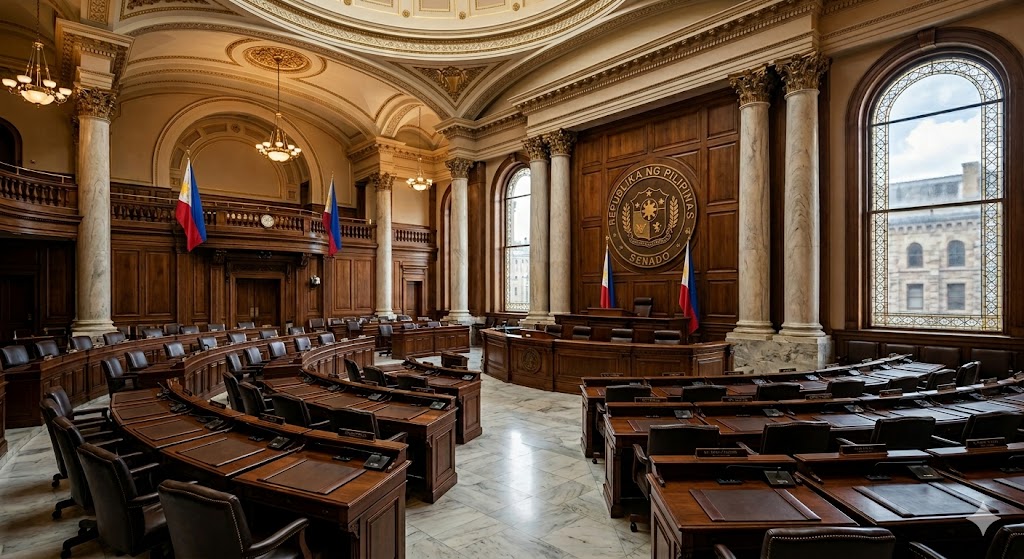
The possibility that a member of the Philippine Senate might permanently cast a vote on pending legislation from a remote location, authenticated by a digital platform, while a chamber in Manila formally registers that vote toward the constitutionally required quorum, was not within the operational imagination of the Constitutional Commission of 1986. Yet that possibility is no longer speculative. The Senate has acted. And the constitutional question — whether a permanent remote voting rule, applicable on a standard of individual “justifiable grounds” outside of any declared national emergency, is a valid exercise of legislative rulemaking autonomy or an impermissible structural redesign of the conditions of legislative legitimacy — demands analysis that matches the seriousness of the institutional act.
This article does not approach that question with a predetermined conclusion. The constitutional arguments on both sides are substantial, and intellectual honesty requires that they be presented as such. The case for the rule’s validity draws on the textually explicit and judicially recognized plenary character of legislative rulemaking power, on a purposivist reading of the quorum requirement that measures compliance against functional goals rather than historical forms, and on a legal realist appreciation of the operational demands of modern governance in a geographically dispersed archipelagic state. The case against draws on a structuralist reading of Article VI, Section 16(2) as a coherent architectural unit whose interlocking mechanisms — quorum, adjournment, compellability — collectively presuppose physical assembly as a condition of constitutional validity, and on a theory of legislative deliberation that treats physical co-presence not as an arbitrary formal requirement but as a functional precondition for the kind of interactive, accountable lawmaking the Constitution institutionalizes.
This article proceeds in five parts. Part II examines the procedural architecture of judicial review in this context — the threshold requirements of an actual case or controversy, standing, and the factual record that would attend a Rule 65 petition challenging a remote voting rule, and the doctrinal tension between the Court’s expanded jurisdiction under Article VIII, Section 1 and the continuing necessity of concrete adversarial facts. Part III presents the dialectic between the two substantive constitutional positions, analyzing the plenary rulemaking case and the structural constitutional case with equal rigor and without foreclosing the question the Constitution itself leaves genuinely open. Part IV proposes a framework of digital constitutionalism that distinguishes between constitutionally compatible and constitutionally incompatible forms of technological adaptation in the legislative context. Part V concludes with reflections on the implications of this analysis for Philippine democratic governance and constitutional jurisprudence.
The central thesis of this article is not a simple holding for one side. It is a methodological and substantive claim: that the constitutional question presented by permanent remote voting cannot be resolved by invoking either the plenary character of the rulemaking power or the historical meaning of attendance in isolation, but only by a structural reading of Article VI, Section 16 as a coherent architectural whole — and that such a reading, honestly conducted, reveals that the permanent remote voting rule, as described, likely crosses from adaptive rulemaking into transformative constitutional redefinition, while leaving open a narrower space for emergency-conditioned and constitutionally-anchored accommodations of remote participation.
II. THE PROCEDURAL PATHWAY: RULE 65, EXPANDED JURISDICTION, AND THE GATEKEEPING FUNCTION OF JUSTICIABILITY
A. The Expanded Jurisdiction of the Supreme Court Under Article VIII, Section 1
Any judicial challenge to the Senate’s remote voting rule would most naturally be framed as a petition for certiorari under Rule 65 of the Rules of Court, invoking the Supreme Court’s expanded jurisdiction under Article VIII, Section 1 of the 1987 Constitution. That provision, in its second paragraph, defines judicial power to include “the duty of the courts of justice to settle actual controversies involving rights which are legally demandable and enforceable, and to determine whether or not there has been a grave abuse of discretion amounting to lack or excess of jurisdiction on the part of any branch or instrumentality of the Government.”
The expanded jurisdiction represents the Constitutional Commission’s most direct response to the institutional crisis of the martial law years, when the Supreme Court’s self-restraint — its reluctance to intervene in what it characterized as political questions or acts of executive discretion — became an instrument of authoritarian consolidation. The provision deliberately dismantles the traditional political question doctrine as a categorical bar to judicial review, substituting for it a positive mandate: courts must determine whether any branch of government has gravely abused its discretion, regardless of whether the subject matter of that abuse would traditionally be characterized as political rather than legal.
The significance of this provision for the remote voting question is substantial. A challenge to an internal Senate rule — the paradigmatic political question under pre-1987 doctrine — would, under the expanded jurisdiction, be cognizable before the Court to the extent that the adoption of the rule constitutes a grave abuse of discretion amounting to lack or excess of jurisdiction. The Court could not dismiss such a petition solely on the ground that internal legislative rules are committed to the exclusive discretion of the legislative branch. The constitutional text forecloses that categorical response.
What the expanded jurisdiction does not do, however, is eliminate the requirement that there be a genuine, concrete controversy before the Court. This distinction — between the scope of what the Court may review and the conditions under which that review may be invoked — is fundamental
to a coherent theory of judicial power, and its importance in the remote voting context cannot be overstated.
B. The Actual Case or Controversy Requirement and Its Structural Rationale
The same Article VIII, Section 1 that provides the expanded jurisdiction also contains, in its first sentence, the requirement that the Court settle “actual controversies involving rights which are legally demandable and enforceable.” This is the Philippine constitutional formulation of the case or controversy requirement — the principle that courts exercise judicial power only in the resolution of genuine disputes between parties with real, identified, personal stakes in the outcome.
The case or controversy requirement is not a procedural inconvenience imposed by formalists to insulate government action from legal challenge. It is a structural feature of the judicial power whose rationale operates on multiple levels simultaneously. At the institutional level, it maintains the separation of powers by ensuring that the Court does not function as an advisory committee to the government — issuing constitutional opinions on legislative drafts or policy proposals before they have been applied to produce concrete consequences. At the epistemological level, it ensures that constitutional adjudication is grounded in facts — the specific, contextual, operational facts that reveal how a challenged rule actually functions in practice, as opposed to how it appears on paper. At the legitimacy level, it ensures that constitutional rulings are generated by the necessity of resolving real disputes, giving them the democratic warrant that advisory opinions lack.
A petition challenging a permanent remote voting rule filed immediately upon the rule’s adoption — before any Senator has attended a session remotely, before any quorum has been constituted partly by remote participants, before any legislation has been enacted under its authority — presents a significant case or controversy difficulty. The constitutional questions are real; the potential for constitutional harm is genuine. But the harm itself remains prospective, and the Court’s constitutional pronouncement, issued without knowledge of how the rule operates in the complex institutional environment of Senate proceedings, risks being either over-broad or under-inclusive in ways that a concrete factual record would prevent.
This is not a minor technical objection. It goes to the quality of constitutional adjudication. A ruling on the constitutional validity of remote voting in the abstract — without knowing what “justifiable grounds” has meant in practice, without knowing whether deliberation has been substantively affected or merely physically relocated, without knowing whether authentication mechanisms have proven reliable — produces constitutional doctrine that is logically constructed but factually uninformed. The history of constitutional litigation counsels that such doctrine tends to require rapid qualification or revision when it meets the complexity of institutional reality.
C. Transcendental Importance Doctrine: Proper Scope and Misapplication
Philippine jurisprudence has developed, through a series of public interest cases, the doctrine of transcendental importance — a principle permitting the relaxation of standing requirements when the constitutional questions presented are of surpassing public concern and when, absent judicial intervention, the issue will evade review through normal litigation processes because no private plaintiff suffers the kind of particularized injury that traditional standing doctrine requires.
The doctrine has a legitimate core. Constitutional provisions designed to protect institutional or structural values — the integrity of legislative deliberation, the accountability of public officials, the preservation of the separation of powers — do not benefit any individual in a manner that generates the kind of private, particularized injury ordinarily sufficient for standing. If only persons specifically injured by a piece of legislation passed under a defectively constituted quorum could challenge the quorum rule itself, structural constitutional violations might persist indefinitely, protected from judicial review by the very diffuseness of the harm they cause.
The doctrinal problem arises when transcendental importance is applied not merely to relax standing requirements but to dispense with the requirement of a concrete factual record altogether. These are distinct doctrinal moves with different justifications and different risks. Relaxing standing identifies who may invoke the Court’s jurisdiction in the absence of a traditional private injury; it does not eliminate the need for a concrete controversy from which the Court can reason. Dispensing with factual concreteness entirely — permitting the Court to rule on the constitutional status of a rule that has produced no concrete application, no specific outcome, and no identified injury — transforms the Court’s function from adjudication to legislation, from the resolution of disputes to the issuance of constitutional edicts.
The appropriate application of transcendental importance in the remote voting context would relax standing for challengers — including non-Senator citizens with a generalized interest in the constitutional integrity of legislative proceedings — while still requiring that the challenge be grounded in at least some concrete factual context: a specific session at which a remote quorum was constituted, a specific measure enacted under that quorum’s authority, a specific set of facts sufficient to ground the Court’s analysis in operational reality rather than textual speculation.
A distinct and more textured standing claim would be available to Senators who voted against the adoption of the remote voting rule. Their claim is not a generalized interest in constitutional compliance; it is a structural claim that the rule, by counting remote participants toward quorum, alters the effective conditions of legislative participation in a manner that specifically disadvantages members who rely on the constitutional compellability mechanism — the power to force absent colleagues to physically attend — as a last resort against majoritarian procedural manipulation.
D. The Legislator-Challenger and the Structural Standing Claim
This structural standing claim has greater force than the general citizen-taxpayer version. A legislator’s vote — the primary instrument of representation — is a constitutionally recognized interest, and rules that alter the structural conditions under which that vote is cast and counted may produce a sufficiently direct and personal institutional injury to confer standing without requiring the relaxation that transcendental importance provides.
Even this stronger claim, however, faces the temporal problem identified above. The injury a minority Senator would suffer — a vote outcome altered by a quorum made up partly of remote participants who could not have been compelled to attend — remains prospective until the rule is applied in a specific legislative context. Standing, in the technically precise sense, crystallizes at the moment of application, not at the moment of rule adoption.
The practical implication for potential challengers is this: the most procedurally sound challenge to the remote voting rule would arise after a specific vote in which the outcome was affected by the remote-attendance rule — where a quorum was constituted only through the addition of remote participants, and a measure was enacted that would not have passed with only the physically present members. That is when the constitutional injury is concrete, the causal chain is traceable, and the Court’s ruling would be grounded in the operational reality of the rule rather than in abstract predictions about its effects.
E. Direct Filing and the Hierarchy of Courts
The question of whether a Rule 65 challenge to the Senate’s remote voting rule should be filed directly with the Supreme Court, or whether the principle of hierarchy of courts requires initial resort to the Court of Appeals, admits of a straightforward answer in the Philippine procedural context. Constitutional questions of first impression involving the structural integrity of a co-equal branch of government — particularly challenges to acts of Congress — have historically been accepted for original cognizance by the Supreme Court without the requirement of intermediate appellate proceedings, given the Court’s unique constitutional mandate as the ultimate interpreter of the Constitution.
This procedural accommodation for direct filing does not, however, override the substantive requirement of an actual case or controversy with a concrete factual record. These are separate requirements operating at different levels of procedural analysis. The former determines the proper forum; the latter determines the proper time. A petition that is correctly filed directly with the Supreme Court may nonetheless be premature because the factual conditions for meaningful constitutional adjudication have not yet materialized.
III. THE DIALECTIC: LEGISLATIVE AUTONOMY VERSUS CONSTITUTIONAL QUORUM ANCHORS
A. The Case for the Rule’s Validity: Plenary Power, Purposivism, and Digital Realism
1. The Textual and Doctrinal Foundation of Plenary Rulemaking Authority
The affirmative case for the remote voting rule begins with the most natural reading of the constitutional text that authorizes it. Article VI, Section 16(3) provides, without qualification, that “each House may determine the rules of its proceedings.” The text imposes no limitation on the substance of permissible rules, no requirement that rules conform to historical practice, and no exception for rules that affect the conditions of quorum or attendance. On a straightforward reading, the power is as broad as the legislative needs of each House — a power to regulate, in whatever manner each House deems appropriate, the internal conduct of its proceedings.
The doctrinal history of this provision reinforces the textualist case. The Supreme Court of the Philippines, in Santiago v. Guingona, G.R. No. 134577 (1998), 359 Phil. 276, addressed the rulemaking power in the context of an internal Senate dispute over the designation of the Minority Leader. The Court held that the Constitution vests in each House the power to determine its own rules of proceedings and that this power may not be externally constrained by the prescription of any particular procedure. While the case did not directly address the quorum or attendance provisions, its language establishes the high degree of deference courts owe to internal legislative rules — a deference rooted in the separation of powers and in the institutional recognition that each House possesses a democratic mandate to organize itself in the manner its members collectively judge best.
The foundational American statement on legislative rulemaking limits, United States v. Ballin, 144 U.S. 1 (1892), which has been influential as a doctrinal reference point in Philippine constitutional analysis given the textual parallels between Article I, Section 5, Clause 2 of the United States Constitution and Article VI, Section 16(3) of the Philippine Constitution, itself recognized that “within these limitations all matters of method are open to the determination of the house.” Proponents of the remote voting rule would argue, with justification, that the manner in which members participate in proceedings — whether physically present or digitally connected — is precisely a matter of method, within the domain of the rulemaking power as Ballin defines it.
2. The Purposivist Reading of the Quorum Requirement
The purposivist case for the rule’s constitutional validity is, in many respects, the more intellectually sophisticated argument. It proceeds by identifying the purpose of the quorum requirement — the reason the Constitution imposes a majority attendance threshold rather than permitting a small minority to transact legislative business — and then arguing that remote voting satisfies that purpose as effectively as physical presence.
The quorum requirement exists, on this account, to ensure that legislative decisions reflect the participation of a sufficiently representative body of the membership, preventing a small, unrepresentative faction from transacting business without the engagement of the broader membership. A Senator who is authenticated, verified, and participating in a session in real time from Cebu City is, functionally, engaged in the proceedings in precisely the sense the quorum requirement intends: she is aware of what is being debated, she can speak and respond to arguments, she can cast a vote that reflects her considered judgment on the matter before the Senate. The constitutional purpose of ensuring representative participation is satisfied.
On this reading, the insistence on physical co-location is not a constitutional requirement but a historical contingency — a default assumption of the 1987 drafters that reflected the technology of 1987 rather than the purposes of the quorum provision. If the purpose is participation, and digital technology now enables genuine, real-time, fully interactive participation without physical travel, then a reading of the Constitution that requires physical presence is not faithful to constitutional purpose; it is faithful to constitutional form at the expense of constitutional substance.
This is a purposivist argument of real force, and it cannot be dismissed with a reference to the Framers’ intent or to the historical meaning of words. Constitutional provisions must be interpreted to serve their purposes across changing circumstances; a Constitution that can only be applied in the technological conditions of its drafting is not an enduring fundamental law but a historical document of diminishing relevance.
3. The Philippine Geographical Context and the Demands of Modern Governance
The purposivist argument is reinforced, in the Philippine context, by a consideration that has no exact parallel in more geographically compact legislative systems. The Philippines is an archipelagic nation of over 7,600 islands, spanning over 1,800 kilometers from north to south. Senators represent the nation at large, not individual districts, and are elected by a national constituency that includes Filipinos in remote island communities, in far southern Mindanao, and in the distant regions of the Cordillera and the Cagayan Valley. The physical demands of senatorial attendance — regular travel to Manila, extended residence in the capital during session periods, the financial and personal costs of maintaining a constant physical presence in a single metropolitan location — impose burdens that are not trivial and that may, in specific circumstances, interfere with a Senator’s capacity to engage with her constituents in the region she has committed to serve.
A legal realist perspective — one that evaluates legal rules against the backdrop of the social and institutional conditions in which they operate — would insist that any constitutional analysis of the remote voting question account for these operational realities. The Constitution is not implemented in the abstract; it is implemented by real people, in a real country, facing real logistical constraints. A rigid physical-presence requirement that effectively penalizes Senators who take seriously their obligations to geographically distant constituencies is not obviously more democratically virtuous than a carefully regulated remote participation rule.
Moreover, the COVID-19 pandemic demonstrated, with empirical clarity, that digital participation in deliberative bodies is not a theoretical aspiration but an operational reality. Legislative bodies across the world — including bodies in constitutional systems with quorum requirements analogous to the Philippines’ — adopted remote participation mechanisms in response to the pandemic. The fact that these mechanisms functioned, in most cases, without producing the deliberative collapse their critics predicted provides practical evidence that digital participation can serve the constitutional purposes of quorum and attendance requirements, even if it does not replicate every feature of physical co-presence.
4. The Anti-Formalist Critique of Strict Physical Presence Requirements
A related strand of the affirmative case draws on the anti-formalist tradition in legal philosophy — the critique of legal reasoning that insists on adherence to formal categories and historical meanings at the expense of functional analysis. Anti-formalists argue that legal concepts — including constitutional concepts like “quorum” and “attendance” — derive their meaning from the functions they serve rather than from their historical forms, and that a legal system that freezes constitutional meaning in the technological and social assumptions of the founding moment produces increasingly dysfunctional governance as circumstances change.
Applied to the remote voting question, the anti-formalist argument runs as follows: “attendance” in Article VI, Section 16(2) was not defined by the Constitutional Commission as physical presence; it was not defined at all, because physical presence was the only form of attendance the Commission contemplated. The absence of a definition is not a definition; it is a gap, and gaps in constitutional texts are to be filled by reference to constitutional purpose rather than by the importation of historical assumptions. If “attendance” means “engaged participation in proceedings,” then digital presence satisfies the term; if it means “physical co-location in the Senate chamber,” then it does not. The anti-formalist asks: what reason exists to prefer the physical-co-location reading other than the historical contingency that physical co-location was the only form of participation available in 1987? And the answer to that question, the anti-formalist insists, must be functional rather than historical.
B. The Case Against the Rule’s Validity: Structuralism, Deliberation, and the Limits of Rulemaking Power
1. The Ballin Limit and the Distinction Between Method and Condition
The constitutional case against the remote voting rule accepts the plenary character of the rulemaking power but disputes its scope. Drawing on the framework of United States v. Ballin, 144 U.S. 1 (1892) — which specified that a legislative rule is invalid if it “ignores constitutional restraints” and that the rulemaking power extends only to “matters of method” — the structuralist argument draws a distinction that is central to the entire analysis: the distinction between rules that govern the manner of performing a constitutionally required act, and rules that redefine the constitutional conditions of that act’s validity.
Rules of the first type — governing method — are within the rulemaking power. Rules of the second type — redefining constitutional conditions — are not, because the constitutional conditions of legislative validity are fixed by the Constitution itself and are not susceptible to legislative modification through internal rules. The rulemaking power determines how the constitutionally required act is performed; it cannot determine what the constitutionally required act requires.
The remote voting rule, on this analysis, does not merely change the manner in which a constitutionally sufficient assembly deliberates and votes. It changes what counts as a constitutionally sufficient assembly. A quorum, under the Constitution, is a majority of each House. If remote participants may count toward that majority, then the constitutional requirement of a majority is satisfied by a combination of physical and digital presence. But the constitutional text did not specify a majority of physically present members plus digitally connected members; it specified a majority of each House, in a context — as the structuralist argument develops below — that presupposes physical assembly as the baseline condition of membership participation. Redefining the baseline is not method regulation; it is constitutional amendment through rulemaking.
2. The Structural Reading of Section 16(2) as an Interlocking Architectural Unit
The structuralist case against the rule rests most fundamentally on a reading of Article VI, Section 16(2) in its entirety — not as a collection of independent clauses susceptible to piecemeal interpretation, but as a coherent architectural unit whose internal logic reveals the constitutional understanding of quorum and attendance.
Section 16(2) reads: “A majority of each House shall constitute a quorum to do business, but a smaller number may adjourn from day to day and may compel the attendance of absent Members in such manner, and under such penalties, as such House may provide.”
Three interlocking mechanisms are embedded in this single provision. First, the quorum threshold: a majority is required for the transaction of business. Second, the adjournment power: a smaller-than-quorum number may, if physically assembled, exercise the limited procedural function of adjourning. Third, the compellability mechanism: the physically assembled smaller number may, through procedures and penalties of its own design, compel the attendance of absent members.
The internal logic of these three mechanisms reveals that the constitutional scheme contemplates two states of legislative assembly — sufficient and insufficient for business — and provides for the coercive conversion of the latter into the former. The critical insight for the constitutional argument is this: the compellability mechanism is not peripheral to the quorum requirement but constitutive of the constitutional understanding of attendance that the quorum requirement presupposes.
Attendance, under the constitutional scheme, is a condition that may be physically enforced. The smaller number may send the Sergeant-at-Arms; they may impose penalties; they may, through whatever mechanisms the rules provide, compel a Senator’s body to arrive at the chamber. This compellability is not metaphorical. It presupposes a physical condition — the Senator’s absence from the chamber — and a physical remedy — the Senator’s bodily conveyance to the chamber. If “attendance” could be satisfied by digital presence, the compellability mechanism would become constitutionally incoherent: one cannot dispatch the Sergeant-at-Arms to compel a Senator to open a laptop, and the penalty for failure to attend digitally would be structurally different in kind, not merely in degree, from the penalty for failure to attend physically.
The compellability clause, on this reading, is a constitutional specification of what attendance means. It reveals that the Framers — using language drawn from parliamentary tradition in which attendance had always meant physical presence — understood the quorum requirement as a physical threshold, enforceable by physical means. To read “attendance” as encompassing digital presence is not merely to update an assumption; it is to render the compellability mechanism a constitutional nullity, in violation of the principle that constitutional provisions are to be read as operative and meaningful rather than as surplusage.
3. The Deliberative Theory of Legislative Power
The structuralist argument is reinforced by a theory of legislative power that treats deliberation — not merely vote-aggregation — as the constitutional premise of lawmaking. This theory, rooted in the design of Article VI as a whole, holds that the Senate is constitutionally constituted as a deliberative body: one whose decisions derive their democratic legitimacy not merely from the counting of votes but from the process of collective argument, persuasion, and responsive reasoning that precedes the vote.
Physical co-presence, on this account, is not a formality incidental to the deliberative function. It is a condition that facilitates specific and irreplaceable dimensions of deliberative engagement. The informal interactions that occur in the corridors before and after sessions, the visible discomfort or enthusiasm of a colleague that signals the political costs or benefits of a position, the social pressure of being publicly seen to engage or disengage with a critical debate — these are not inefficiencies to be optimized away by digital technology. They are the operational texture of deliberative democracy as the constitutional architecture of the Senate presupposes it.
This is an argument that social science research on deliberation and group decision-making supports, though this article does not rely on that research as a constitutional authority. It is an argument that the constitutional design of Article VI — with its multiple reading requirements for bills, its provision for recorded debates in the journal, its authorization of the yeas and nays at the request of one-fifth of the members — textually embeds. Each of these features presupposes a contemporaneous, co-located deliberative process; each reflects a constitutional commitment to lawmaking as a social and interactive act rather than a merely aggregative one. A permanent remote voting rule, by making physical presence optional and indefinitely available on individual request, systematically dismantles this deliberative premise without the constitutional authorization that such dismantlement would require.
4. The Minority Protection Function of Quorum and Its Structural Vulnerability
The quorum requirement performs a function that is less visible in ordinary practice but constitutionally significant: it protects the minority against majoritarian procedural manipulation by ensuring that a minimum body of the membership must be present before business may be transacted. A minority that disagrees with the majority’s agenda retains, as a constitutional last resort, the power to prevent a quorum by strategic non-attendance — forcing the majority to either delay or to invoke the compellability mechanism, which itself creates political costs and public visibility.
A permanent remote voting rule threatens this minority-protection function in a specific and structural way. If the rule vests in an officer — most naturally the Senate President, who belongs to the majority — the discretionary power to determine whether a Senator’s grounds for remote attendance are “justifiable,” it creates the structural possibility that majority members may be granted remote attendance accommodations that ensure the quorum count, while minority members who seek to exercise strategic non-attendance as a constitutional check are denied accommodations or are pressured to participate digitally in proceedings they would otherwise avoid. This structural vulnerability does not depend on a finding of bad faith; it is an inherent feature of any discretionary quorum-composition mechanism vested in a partisan officer.
More fundamentally, the minority’s power of strategic non-attendance is grounded in the constitutional architecture of Section 16(2): the Constitution specifically empowers the assembled minority to compel the attendance of absent members, thereby acknowledging that non-attendance is a constitutionally recognized form of legislative opposition. A rule that converts non-attendance into remote digital non-presence — still technically “attending” for quorum purposes if the presiding officer so certifies — dissolves this constitutional opposition mechanism without the constitutional authorization that such dissolution requires.
C. The Irresolvability of the Binary and the Need for a Mediating Framework
The two positions analyzed above are each constitutionally serious. Neither is frivolous; neither is dispositive. The purposivist argument correctly identifies that constitutional provisions must be interpreted to serve their functions across changing circumstances, that the plenary rulemaking power is real and broadly textual, and that the operational demands of modern governance in an archipelagic state are constitutionally relevant considerations. The structuralist argument correctly identifies that constitutional provisions are interlocking architectural elements whose internal logic constrains interpretation, that the compellability mechanism is incompatible with a digital understanding of attendance, and that the deliberative and minority-protection functions of the quorum requirement extend beyond mere vote-aggregation.
The resolution of this tension cannot be achieved by simply choosing one interpretive methodology over the other. It requires a framework that takes both sets of constitutional considerations seriously — that preserves the adaptive capacity of the rulemaking power while specifying the constitutional conditions within which that adaptation must occur. That is the task of Part IV.
IV. TOWARD A FRAMEWORK OF CONSTITUTIONAL DIGITAL REALISM: ADAPTATION WITHOUT DISSOLUTION
A. The Inadequacy of Binary Constitutional Analysis
The public debate over remote voting in legislative bodies has tended to oscillate between two untenable positions: a categorical prohibitionism that treats any form of remote legislative participation as constitutionally impermissible, and an unlimited permissivism that treats the constitutional adequacy of remote participation as entirely a matter of functional effectiveness, to be assessed against technological capabilities rather than constitutional structure. Both positions fail for reasons that the preceding analysis has made clear.
Categorical prohibitionism proves too much. It would invalidate reasonable accommodations for Senators who are physically incapacitated by illness, stranded by natural disaster, or temporarily unable to travel due to security threats — accommodations that any reasonable constitutional system would make available and that the constitutional text, read fairly, does not foreclose. It treats historical form as constitutional substance, reading the physical-presence assumption of 1987 as a constitutional mandate rather than a contingent default.
Unlimited permissivism proves too little. Taken to its logical conclusion, it would permit the Senate to conduct its entire operations through an asynchronous digital platform, with members voting from home on their own schedules, with no real-time interaction and no physically assembled body. This result is plainly incompatible with the constitutional architecture of Article VI, and its compatibility with the constitutional purposes of deliberation and accountability cannot be maintained with a straight face.
The constitutional question is therefore not whether remote participation is categorically valid or categorically invalid, but where, in the space between the two extremes, the constitutional line falls. Identifying that line requires a principled framework rather than a case-by-case intuition about what seems reasonable.
B. The Adaptive/Transformative Distinction: A Framework for Constitutional Digital Realism
The mediating framework proposed here is grounded in a distinction between two types of legislative rules: adaptive rules and transformative rules. This distinction tracks the Ballin framework’s division between “matters of method” and “constitutional restraints,” but it develops that framework in a manner specifically responsive to the challenges of digital participation.
Adaptive rules modify the manner of performing a constitutionally required act while preserving the constitutional character of that act. They are exercises of the rulemaking power within its proper domain: they answer the question of how the constitutionally-required assembly performs its functions, without altering the constitutional conditions of the assembly’s validity. Adaptive rules may accommodate technological change, individual circumstances, and operational necessities; they are subject to the deferential review that the plenary rulemaking power commands.
Transformative rules modify the constitutional conditions of the act’s validity — the conditions whose satisfaction determines whether the act, when complete, carries constitutional authority. They answer, or purport to answer, the question of what counts as a constitutionally valid assembly, and they do so by redefining the terms — quorum, attendance, presence — that the Constitution itself establishes. Transformative rules are not within the rulemaking power’s proper domain, because the rulemaking power governs procedure within a constitutionally defined institutional structure; it does not govern the definition of that structure.
The application of this framework to the remote voting question turns on the quorum-count question: does the remote voting rule allow remote participants to count toward the constitutional quorum? If yes, the rule is transformative — it redefines what counts as a constitutionally sufficient assembly, which lies beyond the rulemaking power. If no — if remote participants’ votes are counted but remote participants themselves do not count toward quorum, which is constituted only by the physically present — the rule is adaptive, and its validity must be assessed against the standards of reasonableness and non-violation of specific constitutional provisions that the rulemaking power domain requires.
This framework generates the following constitutional conclusions:
A rule that permits a Senator to participate remotely, in real time, with verified identity and full deliberative access, while not counting toward quorum — which must be constituted by physically present members — is constitutionally defensible as an adaptive rule. The constitutional conditions of assembly validity are preserved; the remote Senator’s additional participation enriches deliberation without redefining the constitutional threshold.
A rule that permits remote participants to count toward quorum — so that a majority may be constituted partly or entirely by digitally-present members — is transformative. It redefines the constitutional condition of a valid assembly and lies beyond what the rulemaking power authorizes.
C. The Emergency Exception and Its Constitutional Architecture
The constitutional architecture of the 1987 Constitution itself models the kind of exception that would justify, temporarily and under defined conditions, a departure from ordinary attendance requirements. Article VI, Section 23(2) authorizes Congress to grant emergency powers to the President in times of war or other national emergency — a provision that reflects the constitutional recognition that genuine emergencies may require deviations from ordinary constitutional procedures. The structure of this provision is instructive: the emergency exception is constitutionally grounded (in a declared state of emergency), temporally limited (to the duration of the emergency), and subject to legislative revocation (by a resolution of Congress revoking the delegation).
These structural features — constitutional grounding, temporal limitation, and revocability — define the model for a constitutionally defensible remote voting exception. A temporary rule permitting remote participants to count toward quorum during a formally declared national emergency, when physical assembly is genuinely prevented by circumstances beyond legislative control, would be constitutionally defensible because the necessity that justifies the deviation is constitutionally recognized, the deviation is temporally bounded, and the return to ordinary constitutional conditions is institutionally secured.
The permanent remote voting rule under analysis fails on each of these dimensions. It is not grounded in a declared emergency; it is triggered by individual “justifiable grounds” of indeterminate scope. It is not temporally limited; it is a permanent alteration of the rules of proceedings. And it is not subject to any mechanism of automatic restoration; absent a subsequent rule change, it persists indefinitely. The structural contrast with the emergency model is instructive: the permanent rule lacks every feature that makes emergency deviations from constitutional baselines constitutionally tolerable.
D. Minimum Conditions for Constitutionally Compatible Remote Participation
For the purpose of specifying what adaptive, non-transformative remote participation rules would need to satisfy, the framework proposed here identifies four minimum conditions. These conditions do not represent a constitutional holding — there is, as this article has explicitly acknowledged, no Philippine Supreme Court decision directly adjudicating this question, and these conditions are offered as principled first-principles analysis rather than as derived doctrine. They represent the minimum requirements that a remote participation accommodation would need to meet to be constitutionally defensible as adaptive rather than transformative.
First: Real-time and fully interactive participation. The Senate is a deliberative body; the constitutional premise of participation in its proceedings is engagement with ongoing deliberation, not the asynchronous submission of a vote after the fact. Any form of remote participation that severs the connection between deliberation and decision — that allows a Senator to cast a vote without having participated in the real-time exchange of argument that precedes it — is constitutionally incompatible with the deliberative theory of legislative power embedded in Article VI.
Second: Reliable personal authentication. The constitutional right to vote in Senate proceedings is personal to the Senator; it cannot be delegated, and any authentication mechanism that permits vote-casting by staff, proxies, or unauthorized persons introduces a form of de facto vote delegation without constitutional basis. Authentication standards must be sufficient to establish, beyond reasonable institutional doubt, that the vote is being cast by the Senator personally.
Third: Exclusion from the quorum count. This is the critical condition that distinguishes adaptive from transformative rules. A constitutionally defensible remote voting accommodation counts the remote Senator’s vote — which is a personal legislative act — without counting the Senator’s remote presence toward the constitutional quorum. The quorum, under this framework, is constituted exclusively by physically present members; the remote Senator’s participation is an accommodation, an addition to the deliberative process, not a contribution to the constitutional threshold.
Fourth: Constitutional anchorage in necessity. An accommodation permitting remote participation — even under the foregoing conditions — should be grounded in identifiable necessity rather than mere convenience. The model for this condition is the emergency-triggered exception, though the necessity need not always rise to the level of a formally declared national emergency. Medical incapacitation, verified by independent certification; genuine security threats preventing travel; natural disasters disrupting transportation — these are the kinds of necessity that provide constitutional grounding for remote participation accommodations. The permanent availability of remote attendance on individually self-certified “justifiable grounds” does not provide this constitutional anchorage.
E. The Institutional Dimension: Democratic Accountability and the Visibility of Legislative Action
Any framework for digital constitutionalism must grapple with a dimension of the remote voting question that the formal doctrinal analysis tends to underemphasize: the role of physical legislative presence in sustaining democratic accountability.
Senators are not merely decision-makers; they are public officials whose exercise of legislative power is constitutionally subjected to the scrutiny of constituents, the press, civil society, and opposing political forces. Physical presence in the Senate chamber creates a form of accountability that digital presence cannot fully replicate: the Senator who is seen to walk out during a critical debate, to cast a hurried vote before departing, or to be physically absent during proceedings her constituents care about, is publicly accountable in a manner that the Senator who quietly disconnects from a digital session is not. The Senate gallery is not merely a convenience; it is an instrument of democratic oversight. The physical accessibility of Senators to each other, to journalists, to lobbyists both legitimate and illegitimate, to the public — is a condition of the transparency and accountability that democratic governance requires.
A permanent remote voting rule that makes physical presence optional erodes this accountability dimension in ways that are difficult to quantify but constitutionally significant. The constitutional commitment to transparent and accountable legislative action, embedded throughout Article VI, is not adequately served by a system in which Senators may participate in proceedings from undisclosed locations, shielded from the spontaneous encounters and the public visibility that physical legislative service entails. This is not an argument that can bear the full weight of constitutional invalidation by itself; it is an argument that reinforces the structural case against the rule by identifying a democratic cost that the plenary rulemaking power cannot simply write off as an acceptable price of adaptation.
V. CONCLUSION
The constitutional question posed by the Philippine Senate’s permanent remote voting rule does not admit of resolution through the invocation of any single doctrinal principle. It requires an honest engagement with the competing constitutional values at stake: the genuine plenary authority of each House to determine its rules of proceedings, and the genuine structural demands of a constitutional quorum requirement that is not merely numerical but architectural in its design and deliberative in its purpose.
This article has presented both sides of this constitutional dialectic with the analytical rigor that each merits. The case for the rule’s validity — grounded in purposivist interpretation, the plenary rulemaking power, anti-formalist constitutional theory, and the operational demands of modern governance — is not frivolous. In a different constitutional text, or in a constitutional system whose quorum provision did not embed the compellability mechanism that Article VI, Section 16(2) contains, the purposivist argument might well be dispositive.
But the Philippine Constitution’s quorum provision is not a bare numerical threshold. It is a three-part architectural design — quorum, adjournment, compellability — whose internal logic presupposes physical attendance as a condition susceptible to physical enforcement. That presupposition is not merely an historical artifact; it is a structural feature of a quorum requirement designed to protect deliberation, ensure accountability, and guard the minority against majoritarian procedural manipulation. A permanent rule that allows remote participants to count toward quorum dissolves these structural protections without the constitutional authorization that such dissolution requires, and it exceeds the outer limit of what the rulemaking power — plenary as it is within its proper domain — authorizes.
The framework of digital constitutionalism proposed here charts a principled middle course. It preserves the adaptive capacity of the rulemaking power for genuine emergency situations and for individual-necessity accommodations that do not alter the constitutional quorum count. It draws the constitutional line at the quorum-count question: remote participation that supplements physical assembly without redefining its constitutional conditions is adaptive and valid; remote participation that substitutes for physical assembly by counting toward quorum is transformative and constitutionally infirm.
The broader implications of this analysis extend beyond the specific question of remote voting. They bear on the general methodology by which constitutional courts should approach the challenge of technological change in governance. The answer proposed here is neither reactionary preservation of historical forms nor unconstrained adaptation to functional demands. It is calibrated constitutionalism: careful identification of which constitutional requirements serve enduring structural purposes that must be preserved in any technologically adaptive framework, and which requirements reflect historical contingencies that the rulemaking power may legitimately update.
For the judiciary, the lesson is one of institutional discipline. The constitutional question is serious, and the constitutional answer, when properly presented in a case with a concrete factual record and identifiable parties, is answerable. The court that answers it must be willing to engage the structural argument with the depth it requires — neither reflexively deferring to the Senate’s plenary authority, nor invoking historical textual assumptions without explaining why those assumptions carry constitutional force in a post-digital world. The 1987 Constitution is resilient enough to accommodate that analysis. Its Framers built a document designed to endure. The task of interpretation is to ensure that its endurance is genuine — that the adaptations made in its name preserve rather than dissolve the democratic architecture they embedded.
The Senate chamber, in the constitutional design of the 1987 Philippine Constitution, is not merely a room. It is a condition of legitimate collective action. The question of whether that condition may be permanently relocated to the digital space is not answered by saying that the Constitution does not use the word “physical.” It is answered by reading the Constitution’s words as what they are: the carefully chosen language of people who understood, from immediate and bitter experience, that democratic institutions do not fail all at once. They fail gradually, through the accumulation of small departures from the structural conditions that make them legitimate.
Atty. Bernard D. Bandonell is a CPA-Lawyer. The author wishes to acknowledge M. A. for his contributions to this article and T.B. for cross-checking all cited references. All errors remain the author’s own. The author confirms that all judicial citations in this article have been verified for accuracy of case name, docket number, and date; where direct precedent is absent, this article has explicitly so stated and relied exclusively on foundational constitutional principles.
REFERENCES:
Constitutional Provisions
1987 Constitution of the Republic of the Philippines, Art. VI, §§ 16, 23.
1987 Constitution of the Republic of the Philippines, Art. VIII, § 1.
United States Constitution, Art. I, § 5, cl. 2.
Philippine Jurisprudence
Santiago v. Guingona, G.R. No. 134577 (Nov. 18, 1998).
Tolentino v. Secretary of Finance, G.R. No. 115455 (Aug. 25, 1994).
Foreign Jurisprudence
United States v. Ballin, 144 U.S. 1 (1892).
Note on Citations
Consistent with the methodological commitment stated in the Introduction, this article has not cited any Philippine or foreign judicial decision for a proposition that the cited decision does not directly support. Where constitutional principles have been applied to the digital participation question — a question on which no Philippine Supreme Court decision and no binding American federal appellate decision on the constitutional merits currently exists — the application represents original first-principles analysis, as explicitly acknowledged throughout the article.

